
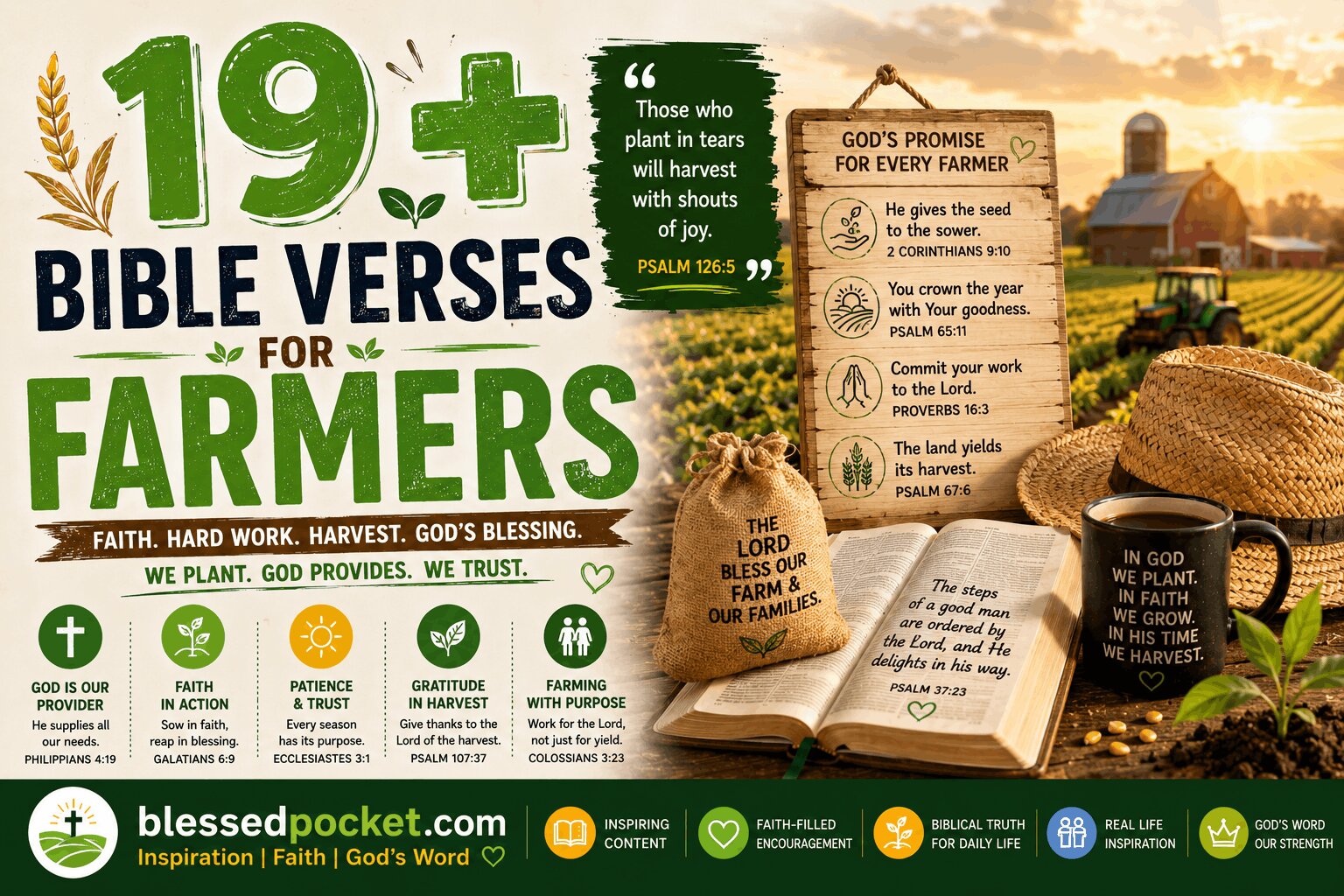
Quick Summary
Introduction: There is no work quite like farming. It begins before the sun comes up and ends long after it goes down.…
Introduction:
There is no work quite like farming. It begins before the sun comes up and ends long after it goes down. It asks everything from you — your back, your hands, your patience, your faith — and then reminds you, every single season, that the final outcome was never entirely in your hands to begin with.
If you’ve been searching for bible verses for farmers, you already know this tension. You know what it means to do everything right — prepare the soil, plant at the right time, tend faithfully — and then watch the weather make its own decision. You know what it means to wait. To trust something you planted in the ground that you can no longer see. To hope for rain when the sky gives you nothing.
And maybe that’s exactly why the Bible speaks to farmers so directly. Not because it was written for a rural age and happens to have some agricultural imagery sprinkled through it. But because farming is one of the most honest pictures of the human experience: we plant, we tend, we wait, we trust — and we depend, whether we acknowledge it or not, on a power far greater than ourselves for the harvest.
The pages of Scripture are filled with farmers. Cain and Abel worked the soil in Genesis. Noah planted a vineyard after the flood. Isaac sowed crops and reaped a hundredfold. Jesus taught in parables about sowers and seeds, wheat and weeds, vines and branches. The prophets promised that the threshing floors would be filled with grain. The Psalms praised a God who waters the earth and makes crops grow.
Farming isn’t just a backdrop in the Bible. It’s a language God uses to explain who He is, how He works, and what He asks of the people who trust Him.
These 19+ bible verses for farmers are organized by the real themes of agricultural life — stewardship, patience, rain and provision, hard work, harvest, dry seasons, and the deep connection between the land and the Lord. Read the ones that fit today. Return when a different season brings a different need.
Why Bible Verses for Farmers Go Deeper Than Motivation
Most articles about bible verses for farmers treat these scriptures like inspiration quotes — something to paste on a barn wall or share on a Facebook post before planting season. And while there’s nothing wrong with encouragement, these verses deserve more than that.
Every bible verse for farmers in this guide was written by someone who understood the land. The writers of Scripture weren’t urban theorists composing agricultural metaphors from a distance. They were people embedded in farming culture — people who knew the fear of a dry spring, the devastation of a failed crop, the bone-deep exhaustion of harvest season, and the almost spiritual quality of watching something you planted push through the soil for the first time.
That context makes these verses land differently when you read them from a tractor seat or a barn or a field that needs rain. They’re not talking at farmers. They’re talking with them — from one person who knows the land to another.
That’s what this guide is trying to give you: not just the verse, but the real, honest, lived meaning behind it.
Quick Navigation: Bible Verses for Farmers by Theme
| Theme | Verses | What It Addresses |
|---|---|---|
| Stewardship & Caring for the Land | 1–4 | Your responsibility as a keeper of God’s creation |
| Planting, Sowing & Faith | 5–8 | The spiritual act of putting seed in the ground |
| Rain, Provision & God’s Timing | 9–12 | Trusting God for what only He can provide |
| Hard Work, Diligence & Faithfulness | 13–16 | The honor of honest labor on the land |
| Waiting, Patience & the Harvest | 17–20 | The long season between planting and reaping |
| Drought, Difficulty & Dry Seasons | 21–24 | When the land and the soul are both parched |
| Rest, Sabbath & Renewal | 25–27 | The God-given rhythm of work and rest |
| Abundance, Blessing & Gratitude | 28–31 | Celebrating what God has grown through your hands |
Part 1: Bible Verses for Farmers About Stewardship and Caring for the Land
Every farmer knows, somewhere in their bones, that the land they work isn’t ultimately theirs. You can hold the deed to a thousand acres and still understand — if you’ve been at it long enough — that you are a steward, not an owner. The land was here before you. It will be here after you. Your job is to care for what was entrusted to you.
This is one of the oldest and most deeply biblical ideas about farming — and it’s one that most bible verses for farmers articles skip over too quickly.
1. Genesis 2:15 (NIV) — The Original Calling
“The Lord God took the man and put him in the Garden of Eden to work it and take care of it.”
Before there was sin. Before the fall. Before thorns and thistles and hard labor entered the picture — there was farming. God placed Adam in a garden and gave him work: tend it, keep it, care for it. This is the very first job description in human history.
The word translated “work” in Hebrew is abad — to serve, to cultivate, to labor. And the word translated “take care of” is shamar — to watch over, to guard, to keep. Together they describe what farming has always been at its best: a service to the creation God made and a guardianship over something entrusted to your care.
If you’re a farmer, you are doing, in some form, the original human calling. That’s not a small thing. This is one of the most foundational bible verses for farmers in all of Scripture precisely because it establishes that tending the land is not a fallback occupation — it is the first vocation God ever gave to a human being.
For the farmer: On the days when the work feels routine or the land feels like a burden rather than a gift — come back to this verse. You are doing what humanity was made to do from the very beginning.
2. Psalm 24:1 (NIV) — Who the Land Belongs To
“The earth is the Lord’s, and everything in it, the world, and all who live in it.”
The land belongs to God. Not to the bank that holds the mortgage. Not to the family name on the deed. Not to the commodity prices that determine its value in a given year. The earth is the Lord’s.
This is simultaneously humbling and liberating. Humbling because it means you hold the land in trust, not in ownership — you are accountable for what you do with it. Liberating because it means the ultimate responsibility for the harvest isn’t yours alone. You work what belongs to God, and He is invested in what happens to His own.
This bible verse for farmers has a way of repositioning the relationship between a farmer and their land. It takes the burden of ultimate ownership off your shoulders and places it where it actually belongs.
3. Leviticus 25:3–4 (NIV) — The Sabbath for the Soil
“For six years sow your fields, and for six years prune your vineyards and gather their crops. But in the seventh year the land is to have a year of sabbath rest, a sabbath to the Lord.”
The concept of a sabbath year for the land is one of the most radical agricultural principles in the ancient world — and one that modern soil science has confirmed is genuinely wise. The land needs rest. It needs fallow seasons. Pushing it to produce without giving it time to recover depletes what makes it productive in the first place.
God built this rhythm into the law of Israel — not just as a spiritual exercise, but as practical land stewardship. The land wasn’t just an instrument for human productivity. It had dignity. It deserved rest. And honoring that rest was an act of faith: trusting that God could provide in year seven without a crop.
For the modern farmer navigating cover crops, crop rotation, and soil health — this ancient verse resonates in surprisingly contemporary ways. One of the most practical bible verses for farmers in the entire Old Testament.
4. Deuteronomy 8:7–10 (NIV) — A Land That God Chose
“For the Lord your God is bringing you into a good land — a land with brooks, streams, and deep springs gushing out into the valleys and hills; a land with wheat and barley, vines and fig trees, pomegranates, olive oil and honey; a land where bread will not be scarce and you will lack nothing… When you have eaten and are satisfied, praise the Lord your God for the good land he has given you.”
God describing farmland. The specificity of this passage is striking — wheat, barley, vines, fig trees, pomegranates, olive oil, honey. God is not vaguely gesturing toward “nature.” He is describing the specific agricultural gifts of a specific land with the delight of someone who designed it to be productive.
The instruction at the end — “praise the Lord your God for the good land he has given you” — makes gratitude the proper posture of anyone who works the earth. The land is given. The productivity is given. The response is worship.
Part 2: Bible Verses for Farmers About Planting, Sowing, and Faith
Putting a seed in the ground is an act of faith. Every farmer knows this, even if they’ve never framed it in theological terms. You’re placing something small and seemingly dead into dark soil, covering it up, walking away, and trusting that something invisible will happen that you cannot engineer, cannot force, and cannot fully understand.
The Bible talks about sowing more than almost any other agricultural act — because it sees in the sower’s gesture a picture of exactly the kind of trust God is asking of all of us.
5. Mark 4:26–28 (NIV) — The Miracle You Can’t Explain
“This is what the kingdom of God is like. A man scatters seed on the ground. Night and day, whether he sleeps or gets up, the seed sprouts and grows, though he does not know how. All by itself the soil produces grain — first the stalk, then the head, then the full kernel in the head.”
Jesus is describing farming to farmers — and He’s pointing to the part of the process that no farmer actually controls. You scatter the seed. You go home. You sleep. You wake up. And somewhere in the dark, something is happening that you didn’t do and cannot explain.
“Though he does not know how.” Jesus acknowledges the mystery directly. The farmer doesn’t know how germination works at a biological level — and neither, ultimately, does anyone. Life coming from a seed is a miracle so familiar we’ve stopped seeing it. Jesus is asking farmers to look at their own fields with fresh eyes.
This is one of the most farmer-specific bible verses for farmers in the Gospels — and one of the most theologically rich. It establishes that the miracle of growth is God’s work, not yours. Your work is the scattering. The sprouting belongs to Him.
6. 2 Corinthians 9:6 (NIV) — The Principle That Governs Everything
“Remember this: Whoever sows sparingly will also reap sparingly, and whoever sows generously will also reap generously.”
Every farmer has lived this verse, even before reading it. You know what happens when you cut corners on seed — you see it in the harvest. You know what happens when you invest fully in the planting — you see that too.
Paul is applying a farming principle to generosity — but the agricultural truth that underlies it is just as real. The relationship between sowing and reaping is not just spiritual metaphor. It’s the governing reality of agricultural life. What goes in, and how fully it goes in, shapes what comes out.
This is one of the bible verses for farmers that moves seamlessly between the practical and the spiritual — speaking to both the physical fields and the broader life of a person who farms with integrity.
7. Psalm 126:5–6 (NIV) — For the Farmer Who Has Sown in Tears
“Those who sow with tears will reap with songs of joy. Those who go out weeping, carrying seed to sow, will return with songs of joy, carrying sheaves with them.”
This is one of the most emotionally honest bible verses for farmers in all of Scripture. It doesn’t describe a farmer planting in perfect conditions with full confidence. It describes someone going out weeping — grieving, struggling, maybe planting in a season where the harvest of the previous year was devastating and they’re not sure they have the courage to plant again.
And the promise is remarkable: those tears don’t disqualify the harvest. They precede it. The one who goes out weeping comes back singing. Not in spite of the weeping — but as its direct sequel.
If you’ve ever had to plant in a season when you weren’t sure why you were still trying — this is your verse.
8. Ecclesiastes 11:6 (NIV) — The Wisdom of Not Waiting for Perfect Conditions
“Sow your seed in the morning, and at evening let your hands not be idle, for you do not know which will succeed, whether this or that, or whether both will do equally well.”
The farmer’s version of “done is better than perfect.” Solomon is saying: you don’t know which planting will produce and which won’t. So plant in the morning. Keep planting in the evening. Don’t wait until you know for certain which effort will pay off — because that certainty never comes.
This is one of the most practically wise bible verses for farmers in the wisdom literature. It honors both diligence and humility — work hard and plant consistently, while releasing the need to control the outcome.
Part 3: Bible Verses for Farmers About Rain, Provision, and God’s Timing
Rain is the thing every farmer talks about and none of them can control. It comes when it comes. It doesn’t come when it doesn’t. And the faith required to be a farmer — in any era, on any continent — includes the faith to trust a God who holds the clouds.
These bible verses for farmers speak directly to that particular kind of trust.
9. Deuteronomy 11:14 (NIV) — The Promise of Rain in Its Season
“Then I will send rain on your land in its season, both autumn and spring rains, so that you may gather in your grain, new wine and olive oil.”
God Himself making a promise about rain. Not just rain in general — rain “in its season.” The timing matters. The autumn rains soften the ground for planting. The spring rains bring the crop to fullness. Both are necessary. Both are God’s gift.
This is one of the most specific bible verses for farmers in the entire Old Testament — because it names the two critical rain events in the agricultural calendar of ancient Israel and promises God’s involvement in both. It establishes God not as a distant creator who wound up the universe and stepped back, but as an active provider who is paying attention to the agricultural calendar His people depend on.
10. Psalm 65:9–10 (NIV) — God the Master Farmer
“You care for the land and water it; you enrich it abundantly. The streams of God are filled with water to provide the people with grain, for so you have ordained it. You drench its furrows and level its ridrows; you soften it with showers and bless its crops.”
This is one of the most beautiful bible verses for farmers in the entire Psalter — because it describes God doing things that any farmer recognizes: watering the land, filling the streams, drenching the furrows, leveling the ridges, softening the soil with showers. These are farming tasks. And the psalmist is saying that ultimately, it is God who does them all.
Every farmer who has watched a much-needed rain come in after weeks of drought has experienced, in some form, what this psalm is describing. The water that fills the irrigation canal came from somewhere. The rain that softened the hardpan soil was sent by Someone. This verse invites you to recognize what you already know.
11. Joel 2:23–24 (NIV) — Rain After Devastation
“Be glad, people of Zion, rejoice in the Lord your God, for he has given you the autumn rains because he is faithful. He sends you abundant showers, both autumn and spring rains, as before. The threshing floors will be filled with grain; the vats will overflow with new wine and olive oil.”
Joel writes this in the aftermath of a devastating locust plague that had destroyed everything. The fields were bare. The harvest was gone. And into that devastation God speaks — and promises rain. Abundant rain. And after the rain, full threshing floors and overflowing vats.
This is one of the most hope-filled bible verses for farmers in the prophetic literature — because it was written to people who had already lost everything and still needed to believe the land could recover. If you’ve been through a devastating crop failure, a drought, a flood, or any agricultural disaster that stripped the year bare — this verse is for you.
12. Matthew 6:26 (NIV) — The Provision Principle
“Look at the birds of the air; they do not sow or reap or store away in barns, and yet your heavenly Father feeds them. Are you not much more valuable than they?”
Jesus says this to people who are anxious about provision — and He uses an agricultural illustration. The birds don’t farm, and God provides for them. How much more will God provide for the people who do farm, who do sow and reap and store, who are engaged in the very act of participating in creation’s provision?
This is not a verse that tells farmers to stop working. It’s a verse that addresses the anxiety underneath the working — the fear that no matter how hard you try, it might not be enough. And Jesus says: you are more valuable to your heavenly Father than the birds He feeds without effort. Trust Him with the outcome.
Quick Reference Table: Core Bible Verses for Farmers
| # | Verse | Reference | Translation | Farming Theme |
|---|---|---|---|---|
| 1 | “The Lord God took the man and put him in the Garden of Eden to work it and take care of it.” | Genesis 2:15 | NIV | Stewardship — the original calling |
| 2 | “The earth is the Lord’s, and everything in it.” | Psalm 24:1 | NIV | God owns the land |
| 3 | “In the seventh year the land is to have a year of sabbath rest.” | Leviticus 25:4 | NIV | Rest for the soil |
| 4 | “When you have eaten and are satisfied, praise the Lord your God for the good land he has given you.” | Deuteronomy 8:10 | NIV | Gratitude for farmland |
| 5 | “All by itself the soil produces grain — first the stalk, then the head, then the full kernel.” | Mark 4:28 | NIV | God grows what you plant |
| 6 | “Whoever sows generously will also reap generously.” | 2 Corinthians 9:6 | NIV | Sowing principle |
| 7 | “Those who sow with tears will reap with songs of joy.” | Psalm 126:5 | NIV | Hope through hard planting |
| 8 | “Sow your seed in the morning, and at evening let your hands not be idle.” | Ecclesiastes 11:6 | NIV | Persistent diligence |
| 9 | “I will send rain on your land in its season.” | Deuteronomy 11:14 | NIV | God’s timing for rain |
| 10 | “You care for the land and water it; you enrich it abundantly.” | Psalm 65:9 | NIV | God as the master farmer |
| 11 | “The threshing floors will be filled with grain.” | Joel 2:24 | NIV | Restoration after devastation |
| 12 | “Your heavenly Father feeds them. Are you not much more valuable than they?” | Matthew 6:26 | NIV | Provision and trust |
Part 4: Bible Verses for Farmers About Hard Work, Diligence, and Faithfulness
Farming is hard. There is no other word for it. The romanticized version — the golden fields, the peaceful barn at sunset, the simple life close to the land — is real, but it doesn’t tell the full story. The full story includes the 4 a.m. alarm during calving season. The machinery that breaks down at the worst possible moment. The market prices that don’t justify the labor. The weather that wipes out months of work in an afternoon.
These bible verses for farmers honor the hard work. Not as something to endure, but as something with genuine dignity and spiritual weight.
13. Proverbs 12:11 (NIV) — The Dignity of Farm Work
“Those who work their land will have abundant food, but those who chase fantasies have no sense.”
One of the most direct bible verses for farmers in the wisdom literature — and one of the most refreshingly un-romanticized. Solomon isn’t talking about farming as a spiritual exercise. He’s talking about it as a practical reality: the person who works the land eats. The person who chases fantasies goes hungry.
There’s a quiet dignity in that plainness. Farming is honorable not because it’s poetic but because it is productive. It feeds people. It provides. And the farmer who shows up every day and does the work — regardless of inspiration or ideal conditions — is the one who has food.
14. 2 Timothy 2:6 (NIV) — The Farmer Who Works First
“The hardworking farmer should be the first to receive a share of the crops.”
Paul uses farming as an illustration for ministry — but the principle he draws from is explicitly agricultural: the hardworking farmer deserves the first portion of the harvest. Hard work has first claim on the reward.
This is one of the bible verses for farmers that simply honors the farmer. Not as a metaphor. As a person whose work earns them the first share of what they produced. In a world that increasingly doesn’t understand where food comes from or what it costs to produce — this verse is a quiet, biblical affirmation of the farmer’s rightful place at the table.
15. Proverbs 20:4 (NIV) — The Cost of Not Working When It’s Time
“Sluggards do not plow in season; so at harvest time they look but find nothing.”
Every farmer understands this verse viscerally. There is a window for planting. Miss it, and no amount of future effort makes up for it. The soil has a readiness that doesn’t wait for your convenience. The season opens and it closes, and what you did or didn’t do during that window is what determines what you find — or don’t find — at harvest.
Proverbs is talking about laziness, but every farmer knows the broader truth here: timing matters. Doing the right thing at the wrong time is almost as problematic as not doing it at all. This is one of the most practically true bible verses for farmers in Solomon’s wisdom collection.
16. Colossians 3:23 (NIV) — Working for an Audience of One
“Whatever you do, work at it with all your heart, as working for the Lord, not for human masters.”
For the farmer who is tired of working for commodity prices, bank loan deadlines, and market forces that feel indifferent to everything they’ve invested — this verse reframes the entire enterprise. You’re not ultimately working for the market. You’re not working for the landlord or the lender or the neighbor who keeps comparing yields. You’re working as if God is watching every acre.
And He is. Every row planted faithfully. Every animal cared for with integrity. Every decision made with both wisdom and conscience. This is one of the bible verses for farmers that turns ordinary farm work into an act of worship — not by making it dramatic, but by revealing who the audience really is.
Part 5: Bible Verses for Farmers About Waiting, Patience, and the Harvest
If farming teaches you anything, it teaches you how to wait. You can’t rush a crop. You can’t negotiate with a growing season. You can’t anxiety your way to an earlier harvest. The land moves at its own pace — and that pace is ultimately God’s pace.
These bible verses for farmers speak to the long middle — the weeks and months between planting and harvest when all you can do is tend, trust, and wait.
17. James 5:7–8 (NIV) — The Farmer as the Model of Patient Faith
“Be patient, then, brothers and sisters, until the Lord’s coming. See how the farmer waits for the land to yield its valuable crop, patiently waiting for the autumn and spring rains. You too, be patient and stand firm, because the Lord’s coming is near.”
James doesn’t use an athlete or a scholar or a king as his model of patience. He uses a farmer. Because farmers understand, in their bones, a kind of patience that most people only theorize about. You plant. You wait. You can’t hurry it. You water when you can, tend when you should, and then you wait for rain that only comes from above.
James is saying to the entire Christian community: be like that. Be like the farmer who doesn’t panic when the rains are late because they understand that the rain has its time and the harvest will come. This is not just one of the great bible verses for farmers — it is a verse that holds up the farmer’s posture as the model for all of Christian faith.
18. Galatians 6:9 (NIV) — Don’t Walk Away From the Field
“Let us not become weary in doing good, for at the proper time we will reap a harvest if we do not give up.”
“At the proper time.” Not your time. Not the time you planned. The proper time — the time appointed by a God who sees the whole growing season when you can only see today.
This is one of the most beloved bible verses for farmers precisely because it speaks to the season when giving up actually makes sense to the rational mind. The harvest is delayed. The effort is immense. The visible results are not yet there. And the verse says: don’t give up. The harvest is real. It’s coming. But you have to still be in the field when it arrives.
Every farmer who has made it through a hard year to a good harvest understands this verse not as theology but as lived experience.
19. Psalm 126:6 (ESV) — Going Out Weeping, Coming Back Singing
“He who goes out weeping, bearing the seed for sowing, shall come home with shouts of joy, bringing his sheaves with him.”
The image is unforgettable: a farmer going out in tears to plant, and coming home with armloads of grain, singing. The tears and the sheaves belong to the same story. The weeping doesn’t cancel the harvest — it precedes it. The farmer didn’t stop planting because they were grieving. They planted through the grief. And the harvest came.
This is one of the most emotionally honest bible verses for farmers in the entire Bible — because it doesn’t ask you to pretend the hard seasons aren’t hard. It just asks you to keep planting through them.
20. Isaiah 55:10–11 (NIV) — The Word That Goes Out and Accomplishes
“As the rain and the snow come down from heaven, and do not return to it without watering the earth and making it bud and flourish, so that it yields seed for the sower and bread for the eater, so is my word that goes out from my mouth: It will not return to me empty, but will accomplish what I desire and achieve the purpose for which I sent it.”
God uses the rain-to-harvest cycle to describe the certainty of His Word — and in doing so, He gives farmers one of the most affirming bible verses for farmers in the prophetic literature. The rain that comes down from heaven doesn’t return without watering the earth. It does its work. God’s Word works the same way.
For the farmer, this passage carries a dual gift: the agricultural image honors the farming reality, and the theological application adds an extra dimension of trust. Rain doesn’t fail its purpose. And neither does God.
Part 6: Bible Verses for Farmers About Drought, Difficulty, and Dry Seasons
Some seasons are simply hard. The rains don’t come. The crops struggle. The numbers don’t work. The land that was productive isn’t yielding the way it should. Every farmer has been through at least one season like this — and some have been through many.
These bible verses for farmers are for those seasons. Not to minimize them or fix them with theological platitudes, but to speak into them with the honesty and hope that real faith makes possible.
21. Jeremiah 17:7–8 (NIV) — The Tree That Survives the Drought
“But blessed is the one who trusts in the Lord, whose confidence is in him. They will be like a tree planted by the water that sends its roots by the stream. It does not fear when heat comes; its leaves are always green. It has no worries in a year of drought and never fails to bear fruit.”
The tree in this passage doesn’t survive the drought because of the absence of drought. It survives because its roots go deep enough to reach water that the surface drought can’t touch. The heat still comes. The drought is real. But the tree with deep roots keeps bearing fruit anyway.
This is one of the most deeply comforting bible verses for farmers in the prophetic books — because it doesn’t promise an absence of drought. It promises a rootedness that makes drought survivable. The question it asks of every farmer is: how deep do your roots go? Not the roots of the crop, but yours.
22. Habakkuk 3:17–18 (NIV) — The Hardest and Most Honest Faith Declaration
“Though the fig tree does not bud and there are no grapes on the vines, though the olive crop fails and the fields produce no food, though there are no sheep in the pen and no cattle in the stalls, yet I will rejoice in the Lord, I will be joyful in God my Savior.”
This might be the most remarkable verse in the entire Bible for farmers. Habakkuk names every agricultural failure you can imagine — no figs, no grapes, failed olive crop, no grain, no livestock — and then makes an extraordinary declaration: yet I will rejoice.
Not “I will rejoice because this will get better.” Not “I will rejoice because I have a plan.” Yet I will rejoice. Full stop. In the complete absence of visible agricultural blessing, joy is still chosen because the joy is rooted in who God is, not in what the fields produced.
This is one of the bible verses for farmers that you don’t appreciate fully until you’ve had the year Habakkuk is describing. Then it becomes something you hold onto with both hands.
23. Joel 2:25 (NIV) — The Restoration Promise
“I will repay you for the years the locusts have eaten — the great locust and the devouring locust, the stripping locust and the cutting locust.”
God speaking after a devastating agricultural catastrophe — and promising to restore what was lost. “The years the locusts have eaten” has become shorthand for any prolonged season of loss and devastation. And God’s promise is staggering: He will repay those years. Not just help you move forward, but restore what the destruction took.
For any farmer who has watched a disease, a drought, a market collapse, or an actual pest consume years of investment — this is one of the most hopeful bible verses for farmers in all of Scripture. The restoration is promised. The repayment is coming.
24. Psalm 107:35–37 (NIV) — Turning Parched Ground Into Fruitfulness
“He turned the desert into pools of water and the parched ground into flowing springs; there he brought the hungry to live, and they founded a city where they could settle. They sowed fields and planted vineyards that yielded a fruitful harvest.”
God transforming agricultural impossibility into productivity. Parched ground — the kind that farmers know as hopeless — becoming flowing springs. Hungry people settling and planting and reaping a fruitful harvest. The reversal is total. And it is God’s doing.
This is the biblical testimony of what happens when God intervenes in a land that has run dry. And it serves as one of the most hope-sustaining bible verses for farmers for anyone staring at ground that doesn’t look like it can produce anything worth planting for.
Part 7: Bible Verses for Farmers About Rest, Sabbath, and Renewal
One of the countercultural gifts God gives farmers in Scripture is the gift of rest. Not just rest for the farmer, but rest for the land itself. The sabbath principle — woven through both Testaments — recognizes something that soil scientists have confirmed and that generations of farmers have learned the hard way: relentless production without rest depletes what makes production possible.
25. Genesis 8:22 (NIV) — The Covenant of Seasons
“As long as the earth endures, seedtime and harvest, cold and heat, summer and winter, day and night will never cease.”
God’s promise to Noah after the flood. The rhythms of the agricultural year — seedtime and harvest, cold and heat, summer and winter — are God’s covenant commitment. As long as the earth exists, these rhythms will not cease.
For the farmer who wonders whether the seasons will cooperate, whether the land will recover, whether the patterns will hold — this verse is a covenant anchor. The cycles of the agricultural year are not a human system that might break down. They are a divine promise that will hold as long as the earth does.
26. Exodus 23:10–11 (NIV) — Rest for the Land and the Poor
“For six years you are to sow your fields and harvest the crops, but during the seventh year let the land lie unplowed and unused. Then the poor among your people may get food from it, and the wild animals may eat what is left. Do the same with your vineyard and your olive grove.”
The sabbath year for the land served two purposes: rest for the soil, and food for the poor. The land that lay fallow wasn’t wasted — it was opened. The poor could glean from it. The wild animals could eat from it. The rest of the land became provision for the vulnerable.
This gives the sabbath year principle a social dimension that most people miss. Land stewardship, in the biblical framework, is never just about soil health. It’s about community health. The way you manage your land has implications for the people around you who are hungry. One of the most socially rich bible verses for farmers in the entire law of Moses.
27. Matthew 11:28–30 (NIV) — Rest for the Farmer
“Come to me, all you who are weary and burdened, and I will give you rest. Take my yoke upon you and learn from me, for I am gentle and humble in heart, and you will find rest for your souls. For my yoke is easy and my burden is light.”
Jesus uses a farming image — the yoke — to talk about the rest He offers. The yoke was the wooden frame that connected working animals to the load they pulled. A well-fitted yoke distributed the weight properly. A poorly fitted one caused suffering.
Jesus says His yoke is easy — the word in Greek is chrestos, meaning well-fitted, kind, suited to the animal. He’s offering a partnership where the weight is shared and the fit is right. For the farmer who is worn down by burdens that feel too heavy — this is the invitation. Come with your exhausted body and your worried mind and your tired soul. Let Him help carry it.
Part 8: Bible Verses for Farmers About Abundance, Blessing, and Gratitude
Not every season is hard. Some years the rains come right. The crop comes in beautifully. The harvest exceeds what was planted. In those seasons, these bible verses for farmers are the response — gratitude for the abundance that God sends through the faithfulness of your hands and the generosity of His provision.
28. Deuteronomy 28:12 (NIV) — The Open Storehouse
“The Lord will open the heavens, the storehouse of his bounty, to send rain on your land in season and to bless all the work of your hands. You will lend to many nations but will borrow from none.”
“Bless all the work of your hands.” God’s blessing is applied to the specific work — the tangible, physical, daily work of the farmer’s hands. Not a vague prosperity, but a specific benediction on what the hands actually do: plant, tend, harvest, maintain.
The storehouse of heaven opened. The rain sent in season. The work of hands blessed. This is one of the most abundant bible verses for farmers in the entire Torah — a picture of what farming can look like when God is at the center of it.
29. Amos 9:13 (NIV) — Abundance Beyond What Seasons Allow
“The days are coming,” declares the Lord, “when the reaper will be overtaken by the plowman and the planter by the one treading grapes. New wine will drip from the mountains and flow from all the hills.”
A vision of such abundant harvest that the person reaping can’t finish before the next season’s planting begins — because the growth is that lavish, that overflowing, that beyond what normal agricultural cycles would allow. This is God’s picture of restoration and blessing taken to its ultimate expression.
For the farmer, this passage is a vision of what abundance can look like when God removes the limits that scarcity and difficulty have imposed. One of the most gloriously over-the-top bible verses for farmers in the prophetic tradition.
30. Psalm 65:11–13 (NIV) — Creation Singing
“You crown the year with your bounty, and your carts overflow with abundance. The grasslands of the wilderness overflow; the hills are clothed with gladness. The meadows are covered with flocks and the valleys are mantled with grain; they shout for joy and sing.”
The agricultural landscape itself is described as rejoicing. The meadows are covered with flocks. The valleys are mantled with grain. The hills are clothed with gladness. The carts overflow. And all of creation — the grasslands, the hills, the meadows, the valleys — is singing.
This is one of the most beautiful bible verses for farmers in the entire Psalter — a vision of what a blessed growing season looks like when you trace it all the way back to the God who sent the rain, grew the grass, filled the vats, and crowned the year with His bounty.
31. Haggai 2:19 (NIV) — The Blessing Declared Before the Harvest
“Is there yet any seed left in the barn? Until now, the vine and the fig tree, the pomegranate and the olive tree have not borne fruit. From this day on I will bless you.”
God making a declaration of blessing before the harvest has arrived. The fields haven’t produced yet. The trees are still bare. And God says: from this day on I will bless you. The blessing is spoken into a season where there is nothing yet to see.
This is one of the most faith-demanding bible verses for farmers — because it calls you to receive a promise before the evidence arrives. The blessing is declared. Now the farmer has to live in the time between the declaration and the visible harvest, trusting that the word of God is as real as the fruit will be when it finally comes.
Farmer’s Devotional: How to Use These Bible Verses Throughout the Year
Knowing bible verses for farmers is one thing. Weaving them into the rhythm of the agricultural year is another. Here’s how to put these scriptures to work across each season:
Planting Season Begin the planting season with Genesis 2:15 — reminding yourself that this work is the original human calling. Read Mark 4:26–28 as you set seed in the ground — releasing your grip on the outcome and trusting the miracle you can’t explain. Pray Deuteronomy 11:14 as a request for rain in its season.
Growing Season During the long growing weeks, return to Jeremiah 17:7–8 — the tree whose roots go deep enough to survive the drought. Read Psalm 65:9–10 early in the morning — thanking God for watering what you planted. When the waiting feels long, come back to James 5:7–8.
Harvest Season Open harvest with Psalm 126:5–6 — remembering the tears of planting and letting them deepen the joy of the sheaves. Pray Deuteronomy 8:10 at the dinner table after the first harvest meal — expressing genuine gratitude for the good land. Share Galatians 6:9 with anyone who nearly gave up.
Hard Seasons In drought or crop failure or agricultural crisis, go straight to Habakkuk 3:17–18. Don’t skip it because it’s uncomfortable. Let it challenge you to find joy that doesn’t depend on the yield. Then read Joel 2:25 — and hold the restoration promise.
Year-End Reflection Close the year with Psalm 65:11–13 — whether the year was abundant or difficult, name what God provided. Read 2 Corinthians 9:6 and consider how generously you sowed — not just in the field but in the community around you.
A Table of Farming Themes in the Parables of Jesus
Jesus used agricultural parables more than any other type. Here’s a quick reference for the farming imagery in His teachings — a bible verses for farmers resource from the Gospels specifically:
| Parable | Reference | The Farming Image | Spiritual Meaning |
|---|---|---|---|
| The Sower | Matthew 13:3–9 | A farmer scatters seed on four soil types | The condition of the heart determines what the Word produces |
| The Wheat and Weeds | Matthew 13:24–30 | An enemy sows weeds among wheat | Good and evil grow together until the final harvest |
| The Mustard Seed | Matthew 13:31–32 | The smallest seed becomes the largest plant | The kingdom of God grows from small, invisible beginnings |
| The Seed Growing Secretly | Mark 4:26–29 | Seed grows “all by itself” without human understanding | God grows what we plant in ways we cannot explain or engineer |
| The Vine and Branches | John 15:1–8 | Jesus is the vine; we are the branches | Fruitfulness depends on remaining connected to the Source |
| The Fig Tree | Luke 13:6–9 | A fig tree that doesn’t bear fruit gets one more season | God gives time for repentance before judgment |
| The Rich Fool | Luke 12:16–21 | A farmer plans to store abundant grain for himself | Abundance that doesn’t acknowledge God becomes its own kind of poverty |
FAQ: Bible Verses for Farmers
What is the best Bible verse for a farmer?
Many farmers point to James 5:7–8 as the most directly applicable bible verse for farmers — because it uses the farmer’s own experience of patient waiting as the model for godly faith. The farmer waiting for the autumn and spring rains, trusting the process without being able to force the outcome, is exactly the posture God calls all believers to adopt. Other deeply meaningful choices include Psalm 126:5–6 for hard seasons, Galatians 6:9 for perseverance, and Genesis 2:15 for the dignity of the calling.
What does the Bible say about farming and stewardship?
The Bible establishes farming as a sacred stewardship from the very beginning — Genesis 2:15 records God placing humanity in the garden “to work it and take care of it.” Leviticus 25 commands a sabbath year for the land, recognizing that the soil needs rest and that the farmer is a caretaker, not an owner. Psalm 24:1 establishes that “the earth is the Lord’s” — meaning all farming is done in trust, not in ultimate ownership. These bible verses for farmers form the theological foundation for Christian land stewardship.
What does the Bible say about sowing and reaping?
The Bible uses sowing and reaping as one of its most consistent spiritual principles. Galatians 6:7–9 states that “a man reaps what he sows” and calls believers not to give up because the harvest comes “at the proper time.” Psalm 126:5–6 promises that those who sow in tears will reap with joy. Second Corinthians 9:6 establishes that generous sowing produces generous harvest. The principle of sowing and reaping appears in nearly every genre of Scripture — law, wisdom, prophecy, Gospel, and epistle.
Is there a Bible verse about rain for farmers?
Yes — several. Deuteronomy 11:14 promises God will “send rain on your land in its season.” Psalm 65:9–10 describes God watering the land and enriching it abundantly. Joel 2:23 speaks of God sending “abundant showers, both autumn and spring rains.” Isaiah 55:10 uses the image of rain accomplishing its purpose in the earth as a picture of how God’s Word never fails. These bible verses for farmers about rain are particularly meaningful in seasons of drought or uncertain weather.
What Bible verse talks about waiting for the harvest?
James 5:7 is the clearest verse: “See how the farmer waits for the land to yield its valuable crop, patiently waiting for the autumn and spring rains.” Galatians 6:9 adds: “At the proper time we will reap a harvest if we do not give up.” And Psalm 126:6 gives the emotional arc of harvest waiting: going out in tears, coming back with singing and sheaves. Together these bible verses for farmers create the complete picture of faithful, patient harvest expectation.
What does the Bible say about hard work in farming?
Proverbs 12:11 states plainly: “Those who work their land will have abundant food.” Proverbs 20:4 warns that those who don’t plow in season will find nothing at harvest. Second Timothy 2:6 says “the hardworking farmer should be the first to receive a share of the crops” — honoring agricultural labor with first-priority compensation. Colossians 3:23 reframes all farm work as service to God: “work at it with all your heart, as working for the Lord.” These bible verses for farmers collectively honor the hard, honest labor that farming requires.
What is a good Bible verse for a farmer facing crop failure or drought?
Habakkuk 3:17–18 is the most raw and honest bible verse for farmers facing total agricultural failure: “Though the fig tree does not bud and there are no grapes on the vines, though the olive crop fails and the fields produce no food… yet I will rejoice in the Lord.” Joel 2:25 offers the restoration promise: “I will repay you for the years the locusts have eaten.” And Jeremiah 17:7–8 offers the image of the tree with roots deep enough to keep bearing fruit even in a year of drought.
What did Jesus say about farming?
Jesus used farming imagery throughout His teaching — more than any other occupation. His parables included the sower and four soils (Matthew 13), the wheat and weeds (Matthew 13), the mustard seed (Matthew 13), the secretly growing seed (Mark 4), and the vine and branches (John 15). He also referenced farmers in His teaching on provision (Matthew 6:26), on patience (Luke 13:6–9), and on the folly of abundance without God (Luke 12:16–21). For Jesus, the farming world wasn’t just background scenery — it was the primary language through which He explained the kingdom of God.
Is there a morning devotional Bible verse for farmers?
Psalm 65:9 works beautifully as a morning verse: “You care for the land and water it; you enrich it abundantly.” It sets the posture for the day — acknowledging God’s active role in what the land produces before you’ve done anything yet. Lamentations 3:22–23 (“His mercies are new every morning; great is your faithfulness”) works equally well. And Proverbs 3:5–6 (“Trust in the Lord with all your heart… and he will make your paths straight”) is a good anchor before a day full of decisions that depend on conditions you can’t control.
A Closing Word: The Farmer Who Trusts
There’s a reason Jesus kept coming back to farming in His parables. It wasn’t because it was convenient imagery. It was because farming is one of the most honest and complete pictures of what it means to live by faith.
You prepare everything you can prepare. You plant what you have. You tend what you’ve planted. You pray for rain that only comes from above. You wait through a growing season you can’t rush. And then — if the rains come, if the soil responds, if the seeds germinate and the crops mature — you come in from the field at harvest with something you didn’t have the power to create alone.
That’s farming. And that’s faith.
Every bible verse for farmers in this guide is pointing to the same reality: the farmer who trusts God with the outcome — who plants faithfully, tends diligently, waits patiently, and receives gratefully — is living out one of the most complete expressions of biblical faith that exists.
You might be in a planting season right now. Or a growing season. Or a harvest. Or a drought. Whatever the season — there is a verse here that speaks to it. Return when the season changes. Let the Word grow with you through every cycle of the year.
May God send rain in its season on your land. May your threshing floors be filled with grain and your vats overflow with new wine and oil. May the work of your hands be blessed by the One who made the soil, holds the rain, and never forgets the farmer who trusts Him.
Which of these bible verses for farmers speaks most to the season you’re in right now? Drop it in the comments — and tell us what you’re farming and what you’re believing God for this season. Your story is part of the harvest too.

Eden Pen is a storyteller passionate about spreading positivity. As a contributor to Blessed Pocket, she crafts heartfelt content designed to encourage, inspire, and brighten your day, one word at a time.
Eden Pen
<a href="https://blessedpocket.com">Eden Pen</a> is a storyteller passionate about spreading positivity. As a contributor to Blessed Pocket, she crafts heartfelt content designed to encourage, inspire, and brighten your day, one word at a time.