Quick Summary
Introduction There is a reason Psalm 23 is the most searched Bible chapter in America. Not because it is the longest. Not…
Introduction
There is a reason Psalm 23 is the most searched Bible chapter in America.
Not because it is the longest. Not because it contains the most dramatic story. Not because it was written by the most famous person in the Bible — though David certainly qualifies. Psalm 23 is the most searched passage in all of Scripture because it does something that almost nothing else in the world can do: it meets people exactly where they are.
In the valley. In the dark. In the hospital waiting room. In the silence after a loss. In the moments when the weight of life becomes more than a person can carry alone.
Millions of Americans open their phones or computers every single day and type those words — “Psalm 23” — into a search bar. Not always because they know exactly what they are looking for. Sometimes they just know they need it. Something in them remembers hearing it at a graveside, or whispered by a grandmother, or read over them by a pastor at a hospital bedside. And that something pulls them back.
If you are here today — for any reason — you are in the right place. This is a full, verse-by-verse exploration of Psalm 23. Not a rushed summary. Not a surface-level list. A deep, honest look at six short verses that have carried more broken hearts through more dark valleys than almost any other words ever written.
Read slowly. Let it settle. And by the time you reach the end, may you know something you did not fully know when you started: the Shepherd is real, He knows your name, and He is already walking ahead of you.
Background — Who Wrote Psalm 23 and Why?
The Story Behind Psalm 23 — Who Wrote It and What Was Happening?
Before we walk through the verses line by line, it helps to understand who wrote Psalm 23 and from what place in life these words came.
The Author: David
Psalm 23 is attributed to King David — one of the most complex, human, and beloved figures in all of Scripture. David was not born a king. He was born a shepherd boy in Bethlehem, the youngest of eight brothers, the one considered so unimportant that when the prophet Samuel came to anoint the next king of Israel, David was not even called in from the fields.
But God chose him anyway. And David spent years in those fields — watching sheep, protecting them from lions and bears, guiding them through wilderness, and losing sleep over the ones that wandered. When David eventually wrote Psalm 23, he did not write it as a theologian sitting in a library. He wrote it as a man who had been a shepherd himself — who understood from the inside what it meant to be completely dependent on someone stronger, wiser, and more faithful than yourself.
What David Was Going Through
Most scholars believe David wrote Psalm 23 during one of the most turbulent periods of his life — possibly while fleeing from his own son Absalom, who had staged a coup and driven David out of Jerusalem. David was aging, humiliated, running for his life through wilderness terrain, and sleeping in the open. It was against that backdrop — not a peaceful afternoon in a garden — that David wrote the most comforting poem in human history.
That context matters. A lot. Because Psalm 23 was not written by someone who had never suffered. It was written by someone in the middle of suffering — someone who had chosen, in the darkest season of his life, to call God his shepherd anyway.
That is what gives it its power. And that is why it speaks to anyone who has ever been in a dark valley of their own.
Psalm 23 — Full Text (NIV and KJV)
Psalm 23 — Full Text in NIV and KJV
Before the verse-by-verse breakdown, read the full Psalm in both translations. Let it wash over you as a complete piece first.
Psalm 23 (New International Version — NIV)
The Lord is my shepherd, I lack nothing.
He makes me lie down in green pastures,
he leads me beside quiet waters,
he refreshes my soul.
He guides me along the right paths
for his name’s sake.
Even though I walk
through the darkest valley,
I will fear no evil,
for you are with me;
your rod and your staff,
they comfort me.
You prepare a table before me
in the presence of my enemies.
You anoint my head with oil;
my cup overflows.
Surely your goodness and love will follow me
all the days of my life,
and I will dwell in the house of the Lord
forever.
Psalm 23 (King James Version — KJV)
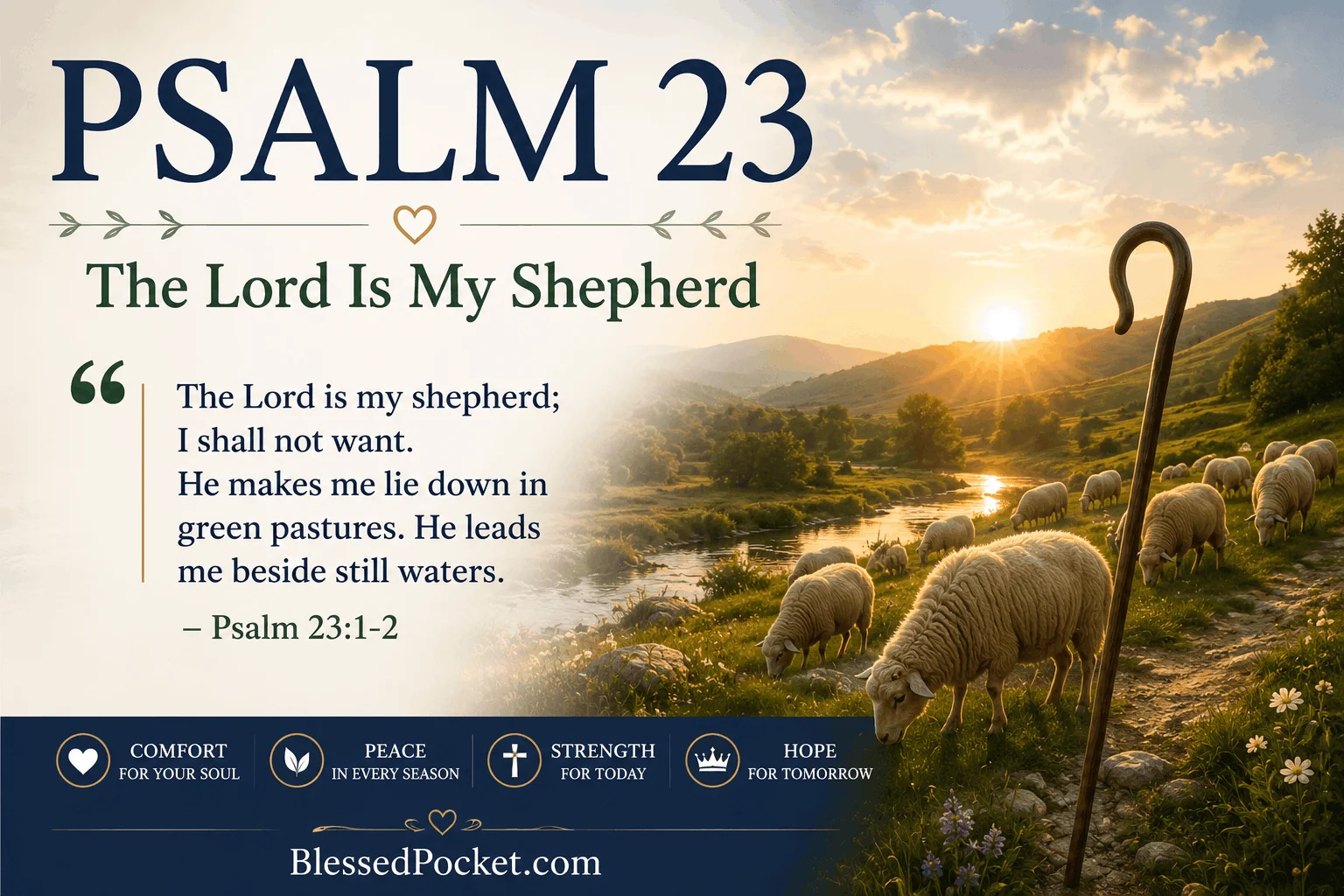
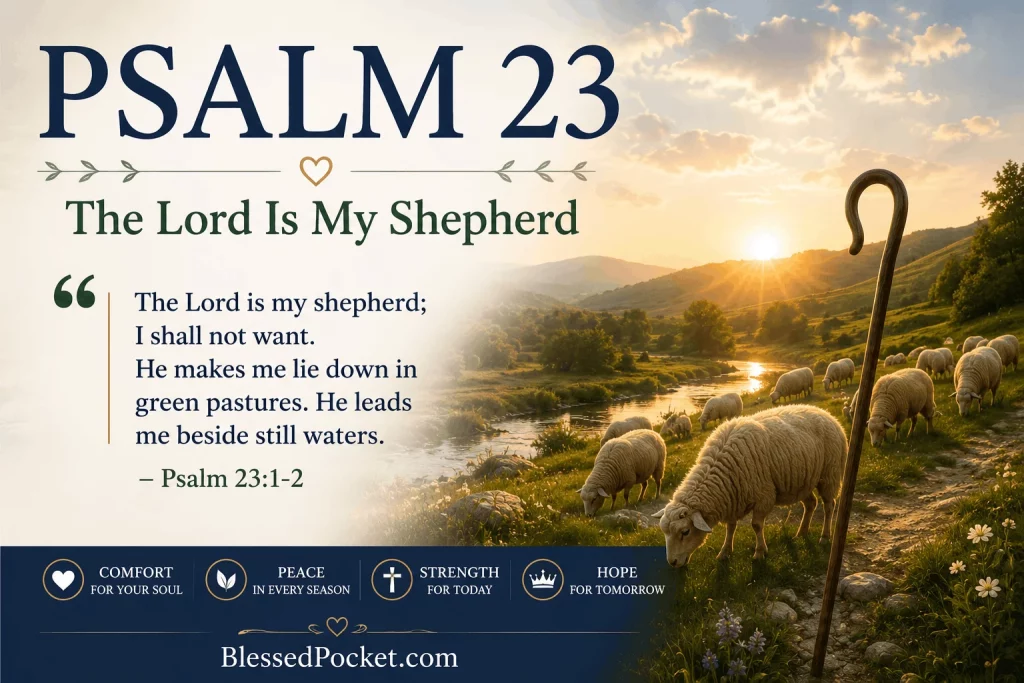
The Lord is my shepherd; I shall not want.
He maketh me to lie down in green pastures:
he leadeth me beside the still waters.
He restoreth my soul:
he leadeth me in the paths of righteousness
for his name’s sake.
Yea, though I walk through the valley of the shadow of death,
I will fear no evil: for thou art with me;
thy rod and thy staff they comfort me.
Thou preparest a table before me
in the presence of mine enemies:
thou anointest my head with oil;
my cup runneth over.
Surely goodness and mercy shall follow me
all the days of my life:
and I will dwell in the house of the Lord
for ever.
Psalm 23 — Verse by Verse Meaning
Psalm 23 Explained: A Deep Verse-by-Verse Breakdown
Now let us walk through Psalm 23 slowly — verse by verse — and unpack what David actually meant, why it still matters, and how it speaks directly into the moments of your life today.
Verse 1: “The Lord is my shepherd; I shall not want.”
Let us start with the most important word in this entire Psalm — and it is not the word you might expect.
It is not shepherd. It is my.
David does not say “The Lord is a shepherd.” He does not say “The Lord is the shepherd.” He says my shepherd. Personal. Specific. Claimed. This is not a general theological statement about the nature of God. It is David planting a flag and declaring: this God — the one who made everything, the one before whom angels cover their faces — is mine. And He has chosen me as His own.
That distinction is everything.
In the ancient world, shepherds were intimately involved with their flocks. They did not manage from a distance. They lived among the sheep, knew each one by name, could identify them in a crowd of hundreds. The shepherd walked first into every danger. He carried the weakest. He stayed up through the night to protect.
When David says “The Lord is my shepherd,” he is declaring that this is the quality of God’s attention toward him. And toward you. God does not watch you from a distance, managing your life with disinterest. He is your shepherd — personally involved, personally committed, personally present.
“I shall not want.”
This phrase in the KJV — or “I lack nothing” in the NIV — is one of the most misunderstood lines in all of Scripture. People sometimes read it as a promise that a Christian will never experience hardship, lack, or unmet desires. But that is not what David is saying — and the rest of the Psalm makes that clear, since it goes on to describe dark valleys, enemies, and seasons of difficulty.
What David is saying is this: with the Lord as my shepherd, I lack nothing that I truly need. The things I need most — presence, guidance, protection, restoration, love, purpose — are all provided. A shepherd does not give the sheep everything they might want. But he ensures they have everything they need to survive and thrive under his care.
That is the promise. And it is more than enough.
Verse 2: “He makes me lie down in green pastures; he leads me beside quiet waters.”
This verse reveals something surprising about how God provides rest: sometimes He makes us lie down.
The word “makes” is important here. Sheep do not lie down easily. They are anxious animals — easily startled, always on the lookout for danger. A sheep will only lie down when it feels completely safe, completely fed, and completely free from the threat of predators. A skilled shepherd creates those conditions intentionally. He finds green pastures — not barren fields — and quiet waters, not raging rivers.
There is deep pastoral knowledge embedded in this verse. Sheep cannot drink from fast-moving water. The current frightens them, and they will not approach it. A good shepherd finds still waters — calm pools, quiet streams — so the sheep can drink without fear.
God does the same for us. He does not always give us rest through the removal of all difficulty. Sometimes He creates pockets of stillness and safety within the storm. The green pastures and still waters of Psalm 23 are not descriptions of a life with no problems. They are descriptions of a Shepherd who knows exactly what His sheep need — and who intentionally creates those conditions, even in the wilderness.
When was the last time you let God make you lie down? When did you last stop running long enough to drink from still waters?
Verse 3: “He refreshes my soul. He guides me along the right paths for his name’s sake.”
Here is where Psalm 23 begins to address something deeper than physical provision.
He restores my soul — or in the NIV, refreshes my soul. This is not about tired bodies. It is about depleted souls. The kind of exhaustion that sleep cannot fix. The kind of emptiness that a vacation cannot fill. The kind of erosion that happens when you have been carrying something too heavy for too long, and you can feel the wear in your spirit.
David knew that feeling well. He had sinned deeply. He had failed as a father. He had run from enemies and made catastrophic mistakes. His soul had been through the kind of damage that no human remedy could repair. And yet — the Shepherd restores it. He does not just patch the damage. He refreshes, renews, and restores.
“He guides me along the right paths for his name’s sake.”
Notice the motivation: for his name’s sake. God does not guide you toward righteousness because you have earned it or because you are especially good at following. He guides you because His own character is at stake. He is a faithful shepherd — and a faithful shepherd does not abandon his sheep to wander. It would reflect poorly on the shepherd.
This is actually one of the most encouraging truths in the entire Psalm: God’s commitment to guiding your life is not contingent on your performance. It is rooted in His own nature. He guides you because that is who He is.
Verse 4: “Even though I walk through the darkest valley, I will fear no evil, for you are with me; your rod and your staff, they comfort me.”
This is the most searched verse in all of Psalm 23 — and one of the most searched Bible verses in the entire world. And the reason is obvious: it speaks directly into the experience that is most universal to every human being who has ever lived.
The dark valley.
The KJV renders it “the valley of the shadow of death” — a phrase so evocative and so deeply embedded in the human consciousness that it has become almost synonymous with grief, loss, terminal illness, and profound suffering. The NIV calls it “the darkest valley.” Both translations capture something true: this is a place of deep darkness, real danger, and the kind of fear that makes your heart race at 3 AM.
But notice what David does not say. He does not say “even though I approach the valley” or “even though I occasionally visit the valley.” He says “even though I walk through” it. The valley is a reality. It is on the path. The Shepherd does not promise to redirect you around every dark valley. He promises to walk through it with you.
The rod and the staff.
A shepherd carried two tools: a staff (a long crook used to guide, rescue, and steady sheep) and a rod (a shorter club used to fight off predators). Both tools speak to the Shepherd’s active protection. He is not passive in the dark valley. He is fighting for you, guiding you, and keeping predators at bay.
The comfort in this verse is not the absence of the dark valley. The comfort is the presence of the Shepherd in it.
Whatever valley you are walking through right now — grief, illness, depression, fear, betrayal, loneliness — the Shepherd is in it with you. That is the promise. That is enough.
Verse 5: “You prepare a table before me in the presence of my enemies. You anoint my head with oil; my cup overflows.”
This verse is where Psalm 23 shifts in a surprising direction — and where many people miss something profound.
The scene changes from a wilderness journey to a banquet table. And that table is set in the presence of your enemies. Not after your enemies have been defeated. Not in a private room away from them. Right there, with them watching.
This is an image of radical, almost defiant, divine hospitality. God does not just protect you from your enemies. He hosts a feast in full view of them — a feast where you are the honored guest, where your head is anointed with oil (a sign of blessing and belonging), and where your cup is not just full but overflowing.
Think about what this means for your life. The blessings of God are not hidden or reserved for some future time when all your problems are resolved. God blesses you now — in the middle of the hard season, in the presence of the opposition, in the places where you feel most vulnerable. He sets the table and invites you to sit down and receive from Him even when everything around you feels like a battle.
“My cup overflows.”
This is abundance. Not just enough — more than enough. Not a sip of blessing to get you through the day, but a cup that runs over. God’s generosity is extravagant. His blessing is not rationed. It overflows.
Verse 6: “Surely goodness and love will follow me all the days of my life, and I will dwell in the house of the Lord forever.”
The final verse of Psalm 23 ends with one of the most confident declarations in all of Scripture. And it is worth noting how it begins: surely.
David does not end with “I hope” or “perhaps” or “if I am faithful enough.” He ends with surely. Certainly. Without question. This is not wishful thinking. This is settled conviction — the kind that can only come from a long history with a faithful God.
“Goodness and love will follow me.”
The word translated “love” here is the Hebrew word hesed — one of the richest words in the entire Old Testament. It means covenant love. Steadfast, loyal, unbreakable love. Not the love that comes and goes depending on how you perform. The love that binds itself to you and refuses to let go no matter what.
David says this love — this hesed — will follow him. The Hebrew word here actually means to pursue. Goodness and covenant love are not passive blessings that wait for you to find them. They are active, pursuing you. Following you. Chasing you through every season of your life.
And the final promise: “I will dwell in the house of the Lord forever.”
This is the ultimate destination of the Shepherd’s care. Not just a safe journey through the dark valley. Not just provision in the wilderness. But eternity in God’s presence. The whole journey — every green pasture, every still water, every dark valley, every abundant table — has been leading here. Home. With the Shepherd. Forever.
Why Psalm 23 Is the Most Searched Bible Passage in America
Why Do Millions of Americans Search for Psalm 23 Every Day?
The research is remarkable. Bible Gateway — viewed hundreds of billions of times in 2025 — reported that Psalm 23:4 was the single most searched Bible verse, with all six verses of Psalm 23 claiming the top six spots on their entire list.
Why? What is it about six short verses written by a shepherd-king three thousand years ago that makes them the most searched words in all of Scripture in modern America?
The answer is both simple and profound.
America is in a dark valley.
The top searched verses of 2025 — Isaiah 41:10, Philippians 4:6, and Psalm 23 — indicate a world that is traumatized. As one theologian put it: “The Church is no longer being asked to prove God exists; we are being asked to prove God cares.”
People are not searching for Psalm 23 because they want a theological discussion. They are searching for it because they are scared, grieving, lonely, exhausted, and desperate to know that Someone is with them in it. And Psalm 23 answers that question in six verses better than almost anything else ever written.
It speaks to grief — and millions of Americans are grieving.
It speaks to fear — and fear is at an all-time high.
It speaks to the dark valley — and many people feel like they have been living in one.
It speaks to a God who is present, personal, and pursuing — and that is exactly the God a hurting world needs to hear about.
Psalm 23 is not trending because it is a popular piece of literature. It is trending because it is true. And truth, when it meets genuine pain, does something that nothing else can.
How to Pray Psalm 23
A Personal Prayer Based on Psalm 23 — Pray This When You Need God Most
If you are in a dark valley right now — or if you simply want to pray the truth of Psalm 23 over your own life — here is a personal prayer drawn directly from its six verses. Pray it slowly. Make it yours.
“Lord, You are my shepherd. Not a shepherd in general — mine. Personally, specifically, intimately mine. And because You are my shepherd, I choose to believe today that I have everything I truly need. Even when it does not feel that way.
Lead me to the green pastures and still waters I cannot find on my own. When my body is tired and my soul is depleted, restore me. Refresh me in the places that feel empty. Guide my steps along the right path — not because I have earned it, but because Your name is faithful and You will not abandon me.
And Lord, when I walk through the dark valleys — and I know they are coming, and some of them I am already in — help me to remember that You are with me. Let Your rod and Your staff be the things I feel most clearly in the dark. Let Your presence be the comfort I cannot manufacture on my own.
Set Your table before me, even here. Even in the middle of whatever battle I am facing. Anoint my head with Your blessing. Let my cup overflow with Your goodness when I have been convinced it was running dry.
And at the end of all of this — the hard days, the dark valleys, the abundant tables, the quiet waters — let me find myself exactly where You have always been taking me: dwelling in Your house, in Your presence, forever.
I trust You, Shepherd. Lead me. In Jesus’ name, Amen.”
FAQs About Psalm 23
Frequently Asked Questions About Psalm 23
Q1: What is the main message of Psalm 23?
The central message of Psalm 23 is that God is a personal, attentive, and completely faithful shepherd to every person who puts their trust in Him. The Psalm covers the full range of human experience — rest and restoration (verses 1–3), dark valleys and fear (verse 4), abundance and blessing (verse 5), and eternal hope (verse 6) — and presents God as present, active, and trustworthy in every single one of those experiences. The main message is not that life will be easy, but that you will never walk through any of it alone.
Q2: Why is Psalm 23 read at funerals?
Psalm 23 has been read at funerals for centuries because it directly addresses the journey through death and what lies on the other side. Verse 4 — “Even though I walk through the darkest valley, I will fear no evil, for you are with me” — offers extraordinary comfort to those who are grieving, reminding them that the one who has died did not walk through that valley alone. And the final verse — “I will dwell in the house of the Lord forever” — affirms the Christian hope of eternal life. Psalm 23 does not deny the reality of death. It places death within the context of a Shepherd who walks through it with His sheep and leads them safely home on the other side.
Q3: What does “The Lord is my shepherd, I shall not want” mean?
This does not mean that a Christian will never experience need, hardship, or suffering. David himself experienced all three throughout his life. What it means is that with God as your shepherd, you will not lack any of the things that truly matter — His presence, His guidance, His protection, His love, and ultimately His eternal home. The word “want” in the KJV is closer to the concept of lack or deficiency in what is truly essential. A good shepherd ensures his sheep have everything they genuinely need.
Q4: What does “the valley of the shadow of death” mean in Psalm 23?
The phrase refers to any experience of profound darkness, danger, suffering, or proximity to death. In the original Hebrew, the word used is tsalmaveth — a compound of shadow and death that together conveys the deepest possible darkness. Shepherds in David’s time would guide their flocks through literal ravines and gorges where predators lurked and danger was real. David uses this geography to describe the darkest seasons of human life — grief, serious illness, depression, fear, or facing one’s own mortality. The comfort of verse 4 is not that the valley is avoided, but that God walks through it alongside you.
Q5: What does it mean that “my cup overflows” in Psalm 23?
In the ancient world, a host would fill a guest’s cup as an expression of welcome and honor. A full cup meant you were valued. An overflowing cup — one that kept being refilled before it could empty — was the ultimate expression of lavish, generous hospitality. David uses this image to describe the extravagant blessing of God. Not just enough grace to survive. Not just enough peace to get through the day. An overflowing, abundant, running-over supply of God’s goodness. The image is deliberately excessive — because God’s generosity toward His people is deliberately excessive.
Q6: Is Psalm 23 only for people who are dying or grieving?
Not at all — though it is especially comforting in those moments. Psalm 23 speaks to every season of the human experience. Verse 2 speaks to rest and restoration — relevant to anyone who is burned out or overwhelmed. Verse 3 speaks to spiritual renewal — relevant to anyone whose faith feels dry. Verse 5 speaks to God’s blessing in the middle of difficulty — relevant to anyone facing opposition or hardship. The Psalm is not a funeral poem. It is a life poem. It is for every season, every valley, every table, and every step of the journey from beginning to end.
Q7: Why is Psalm 23 the most searched Bible passage in America?
Bible Gateway has more than 20 million unique visitors per month, and Psalm 23 consistently dominates its most-searched lists. The reason is simple: Americans are searching for comfort, presence, and hope — and Psalm 23 delivers all three more powerfully and more accessibly than almost any other passage of Scripture. It is short enough to memorize, deep enough to spend a lifetime in, and personal enough that it feels like it was written specifically for whoever is reading it. In a nation navigating grief, anxiety, and uncertainty, Psalm 23 remains the most searched chapter in the Bible because it remains the most honest, the most comforting, and the most true.
Q8: How should I use Psalm 23 in my daily life?
There are many beautiful ways to make Psalm 23 part of your daily rhythm as a Christian. You could memorize it in your preferred translation and recite it each morning as a declaration of trust in God. You could use it as a nightly prayer, working through one verse per day and sitting with its meaning. You could write out a verse on an index card and keep it somewhere visible during a difficult season. You could pray it over a loved one who is going through a dark valley. Or simply open to it whenever fear or anxiety rises — and let the words of a shepherd-king, written three thousand years ago, speak the truth that your heart needs to hear.
Related Articles You Will Find Helpful
More Scripture Studies and Christian Content on This Blog
If Psalm 23 spoke to your heart today, here are more articles on this blog that you will want to read next:
- Psalm 91 Explained — The Protection Psalm and what every verse means for your life today
- Bible Verses for Anxiety — Scriptures for when worry will not let you rest
- Bible Verses When Feeling Sad — 28 comforting scriptures for heavy-hearted days
- What Does John 3:16 Really Mean? — A deep dive into the most famous verse in the Bible
- Bible Verses for Strength — Scriptures for when you are exhausted and running on empty
- Bible Verses for Healing — God’s promises over your body, mind, and spirit
- The Lord’s Prayer Explained — Verse by verse meaning of the prayer Jesus taught
- Bible Verses About Fear — Scriptures to read when fear feels overwhelming
- Jeremiah 29:11 Meaning — What God’s plan for your future really looks like
- Bible Verses for Grief and Loss — For those mourning someone they loved deeply
- Sunday Blessings — Starting the Lord’s Day with faith and encouragement
- Good Morning Prayers — Begin every day anchored in God’s presence
Conclusion
Psalm 23: Six Verses That Have Never Stopped Being True
Psalm 23 has been read at deathbeds and wedding receptions. It has been whispered in foxholes and hospital rooms. It has been memorized by children and recited by the dying. It has been searched on smartphones by people who have not opened a Bible in years and people who have read it every day of their lives.
And it keeps being searched — millions of times a month, all across America — because it keeps being true.
The dark valleys are real. The enemies are real. The fear is real. But so is the Shepherd. So are the green pastures. So is the table He sets in the middle of the hard places. So is the overflowing cup. So is the goodness and love that have been pursuing you since the day you were born.
David wrote Psalm 23 from a dark place — possibly running for his life, sleeping in wilderness, wondering if God had forgotten him. And yet he chose these words. He chose to call God his shepherd. He chose to declare that he would fear no evil. He chose to believe that goodness and love would follow him all the days of his life.
That choice is available to you today, in whatever valley you are standing in.
The Lord is your shepherd. You shall not want. And surely — surely — His goodness and love will follow you all the days of your life.
“The Lord is my shepherd, I lack nothing.” — Psalm 23:1
He is enough. He always has been. 🙏

Eden Pen is a storyteller passionate about spreading positivity. As a contributor to Blessed Pocket, she crafts heartfelt content designed to encourage, inspire, and brighten your day, one word at a time.
Eden Pen
<a href="https://blessedpocket.com">Eden Pen</a> is a storyteller passionate about spreading positivity. As a contributor to Blessed Pocket, she crafts heartfelt content designed to encourage, inspire, and brighten your day, one word at a time.