
Quick Summary
I was thirty-one years old, sitting in a parked car outside a coffee shop, and I had not moved in forty minutes.…
I was thirty-one years old, sitting in a parked car outside a coffee shop, and I had not moved in forty minutes.
I had a decision to make. Not a dramatic one — not a life-or-death crisis, not a moral emergency. Just a fork in the road that had been sitting in front of me for three months, and I had prayed about it, made lists about it, talked to people about it, and was no closer to knowing what to do than when it first appeared.
The coffee in the cup holder had gone cold. I remember staring at the rain on the windscreen, watching each drop find its own way down the glass — no two taking the same route, none of them seeming to choose, just moving by the logic of gravity and surface and the particular angle of the car. Something about that image was both calming and maddening. The drops moved without anxiety. I was a mess.
I had been a minister for six years at that point. I had preached on guidance. I had sat with people in exactly this kind of fog and handed them verses about trusting God and walking in the Spirit. And now I was in the fog myself, and the verses that had felt so confident from the pulpit felt thinner and further away than I had expected.
What I found over the months that followed — through prayer that was more honest than it was eloquent, through Scripture that surprised me with its patience, and through a few conversations with people wiser than me — changed how I understand what God is actually doing when he withholds clarity.
He is not being unkind. He is not testing us in the punitive sense. He is doing something more interesting and more formative — he is making us people who can walk by faith rather than sight, who have learned to move without demanding the full map first.
This guide is what I learned in that parked car, and in the years since.
25+ Bible Verses for Clarity and Direction — My Personal Treasury
When You Cannot See the Next Step
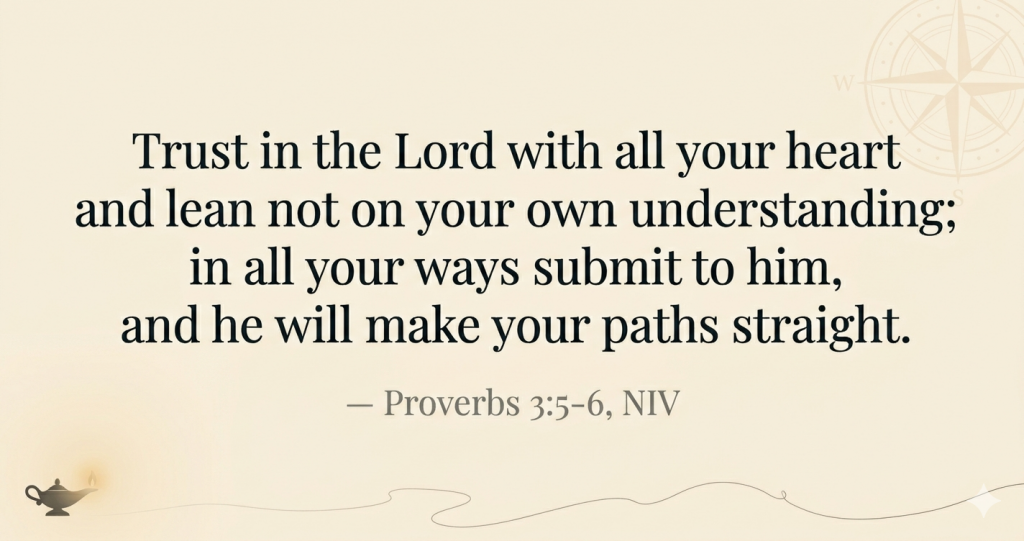
“Trust in the Lord with all your heart and lean not on your own understanding; in all your ways submit to him, and he will make your paths straight.”
— Proverbs 3:5-6, NIV
This was the verse taped to the dashboard of that parked car, eventually. I had known it since I was twelve. It took that particular foggy afternoon to understand what “lean not on your own understanding” actually costs — it costs the security of feeling like you have figured it out, which is the very security I was trying to manufacture by staying in the car longer.
Practice It: Write Proverbs 3:5-6 on a piece of paper and place it somewhere you look when you feel most stuck. Read it as an instruction, not an aspiration.
“Your word is a lamp for my feet, a light on my path.”
— Psalm 119:105, NIV
A lamp for your feet means you can see approximately one step ahead. I spent years frustrated by this verse because I wanted a floodlight. I wanted to see the whole road. God kept offering me the next step, and I kept refusing it because I wanted more information first. The lamp was never going to become a floodlight. The invitation was to move by lamplight and trust that the next step would be lit as I took it.
Practice It: Identify the one step immediately in front of you — not the whole plan, just the next step. Take it today. Trust the lamp.
“Whether you turn to the right or to the left, your ears will hear a voice behind you, saying, ‘This is the way; walk in it.'”
— Isaiah 30:21, NIV
A voice behind you. Not ahead of you, setting the whole route out clearly. Behind you — correcting your course as you move, calling you back when you veer. This is the nature of divine guidance in Isaiah: responsive to your movement, not given in advance of it. You have to move before the correction is available.
Practice It: Make the decision you have been deferring. Move. Then listen for the course-correcting voice as you walk.
“I will instruct you and teach you in the way you should go; I will counsel you with my loving eye on you.”
— Psalm 32:8, NIV
God’s eye is on you while he counsels. This is not impersonal instruction — it is a mentor watching you carefully enough to tailor what they are teaching to exactly where you are. The guidance is custom-fitted. It is not one-size-fits-all.
Practice It: Pray Psalm 32:8 as a request today. Ask God to show you specifically — not generally — what he is teaching you in this season.
When You Need God’s Wisdom
“If any of you lacks wisdom, you should ask God, who gives generously to all without finding fault.”
— James 1:5, NIV
The word “generously” here is haplos — without reservation, without calculation, without holding back. God does not parcel out wisdom reluctantly. He gives it the way a fire gives warmth — abundantly, to whoever is close enough to receive it.
Practice It: Ask specifically for wisdom today, out loud, in a prayer of one sentence. James says to ask. Most of us ask vaguely and wonder why the wisdom feels vague.
“The Lord makes firm the steps of the one who delights in him.”
— Psalm 37:23, NIV
The steps — plural, sequential, one at a time. God makes them firm, which implies they need making firm. This is not a verse for people who have everything figured out. It is a verse for people who are stepping out in faith onto ground that feels uncertain.
Practice It: Name one step you have been afraid to take because the ground felt uncertain. Pray Psalm 37:23 over it. Then take the step.
“For I know the plans I have for you, declares the Lord, plans to prosper you and not to harm you, plans to give you hope and a future.”
— Jeremiah 29:11, NIV
This verse was written to people in exile — people who had lost their home, their temple, their national identity. God was not offering them immediate rescue. He was offering them the anchor of knowing that the confusion was not the final story. The plan existed even when no one could see it.
Practice It: If you are in a season that feels like exile — far from where you expected to be — write Jeremiah 29:11 at the top of a page and underneath it, write what you are still hoping for. Leave both on the page.
“Commit to the Lord whatever you do, and he will establish your plans.”
— Proverbs 16:3, NIV
The Hebrew for “commit” here is galal — to roll, to transfer weight. You roll the plan off your shoulders and onto God’s. It is not passive — you still make the plan, you still do the work. But the anxiety about the outcome moves addresses. You are no longer carrying it.
Practice It: Before starting your most stressful work today, say this verse and physically roll your hands away from you — a small, embodied act of releasing the outcome.
When You Are at a Crossroads
“Show me your ways, Lord, teach me your paths. Guide me in your truth and teach me, for you are God my Saviour, and my hope is in you all day long.”
— Psalm 25:4-5, NIV
David prays this while being pursued by enemies. He does not pray “get me out of this mess.” He prays “show me your ways.” The request is for character formation and directional clarity, not just situational rescue. This is the kind of prayer that changes the person doing the praying.
Practice It: Replace “Lord, fix this situation” with “Lord, show me your ways in this situation” in your prayer today and notice how the conversation changes.
“In their hearts humans plan their course, but the Lord establishes their steps.”
— Proverbs 16:9, NIV
The planning is ours. The establishing is God’s. Both are real. God does not ask you to stop planning — he asks you to hold your plans lightly enough that he can adjust the steps as you take them. The person who makes no plans has nothing for God to redirect.
Practice It: Make your best plan for the decision in front of you. Write it down. Then hold it with open hands, genuinely willing to have God adjust it.
“Many are the plans in a person’s heart, but it is the Lord’s purpose that prevails.”
— Proverbs 19:21, NIV
I have made enough failed plans to know that this verse is true from both directions. It is sobering — my plans are not final. But it is also deeply comforting — neither are my mistakes. The prevailing purpose belongs to God, not to me, and he is better at prevailing than I am at planning.
Practice It: Name one plan that failed. Write next to it: “God’s purpose is still prevailing.” See if you can believe it.
Bonus Verse You Have To Try:
When Anxiety Is Clouding Your Thinking
“Do not be anxious about anything, but in every situation, by prayer and petition, with thanksgiving, present your requests to God. And the peace of God, which transcends all understanding, will guard your hearts and your minds in Christ Jesus.”
— Philippians 4:6-7, NIV
Paul is not suggesting that anxiety is easily dismissed. He is prescribing a specific sequence that interrupts it: prayer, petition, thanksgiving, and then the peace arrives — not as a reward for performing the sequence perfectly, but as the natural result of redirecting your attention to the God who holds the situation.
Practice It: Tonight, before sleep, do Philippians 4:6-7 in sequence. Name the anxiety. Pray it. Add one specific thing to be thankful for. See what happens to the ceiling.
“Cast all your anxiety on him because he cares for you.”
— 1 Peter 5:7, NIV
The word “cast” (epiripto) means to throw — with energy, with full release. Peter is not suggesting a gentle setting-down of your anxieties. He is describing a throw. The size of the throw corresponds to the size of the care on the receiving end.
Practice It: Identify your single heaviest anxiety right now. Physically stand up, extend your arms, and throw it — a real, bodily gesture. Then say “he cares for me.”
When You Are Waiting for an Answer
“Wait for the Lord; be strong and take heart and wait for the Lord.”
— Psalm 27:14, NIV
The repetition is intentional. “Wait for the Lord… wait for the Lord.” David says it twice in one verse because the instruction needs repeating. Waiting is not passive in Scripture. It is an active, muscular practice — “be strong and take heart” — that requires more effort than acting would.
Practice It: On a day when the waiting feels unbearable, read this verse twice — once for each “wait.” Let the repetition be the sermon.
“He has made everything beautiful in its time. He has also set eternity in the human heart.”
— Ecclesiastes 3:11, NIV
The timing is God’s. “In its time” — not in your preferred time, not in the time your anxiety is demanding. The Preacher is making a claim about the nature of time itself: God has built beauty into the correct timing of things, and the ache we feel for premature resolution is the eternity God has placed in us, longing for what is not yet fully here.
Practice It: Write the thing you are waiting for, and next to it write “in its time.” Return to it in thirty days and look for what changed.
“Be still before the Lord and wait patiently for him.”
— Psalm 37:7, NIV
Stillness is the spiritual discipline most countercultural to the modern world and most necessary for clarity. The guidance that comes in stillness is not the guidance that comes in frantic activity. The river reveals its depth when it is quiet, not when it is churning.
Practice It: Spend five minutes in complete stillness today — not praying productively, just being present. Let the stillness itself be the practice.
Verses on Walking in Obedience to Receive Guidance
“The Lord is my shepherd, I lack nothing. He makes me lie down in green pastures, he leads me beside quiet waters.”
— Psalm 23:1-2, NIV
The shepherd leads. The sheep follow. The clarity available to the sheep is exactly proportional to their willingness to follow the shepherd’s movement rather than their own instincts. The green pastures and quiet waters are not found independently — they are arrived at by following someone who knows where they are.
Practice It: Ask yourself today: what is the shepherd asking me to follow him toward that I am currently resisting? Take one step in that direction.
“The heart of the discerning acquires knowledge, for the ears of the wise seek it out.”
— Proverbs 18:15, NIV
Wisdom is acquired actively. It does not arrive by osmosis. The ears of the wise are seeking — reading, listening, asking, learning. Clarity follows the person who has done the work of acquiring discernment, not the person who waits for it to appear without effort.
Practice It: Read one chapter of Proverbs today as an act of wisdom-acquisition. Let it be slow, deliberate reading — not checking it off a list.
“Whether you eat or drink or whatever you do, do it all for the glory of God.”
— 1 Corinthians 10:31, NIV
The most reliable navigational principle in the New Testament. When the specific answer is unclear, the governing question is always available: which option most clearly glorifies God? This does not eliminate the difficulty of the decision, but it gives the decision a north star.
Practice It: Apply this question to the specific decision you are facing today: which option most clearly glorifies God? Write your honest answer.
“Blessed is the one who does not walk in step with the wicked or stand in the way that sinners take or sit in the company of mockers, but whose delight is in the law of the Lord.”
— Psalm 1:1-2, NIV
Clarity of direction is downstream of the company you keep and the things that delight you. Psalm 1 does not begin with “seek guidance.” It begins with the conditions that make a person capable of receiving it.
Practice It: Audit the voices you are listening to most regularly this week. Ask honestly whether they are orienting you toward the Lord’s ways or away from them.
Verses on God’s Faithfulness in Leading
“He guides me along the right paths for his name’s sake.”
— Psalm 23:3, NIV
For his name’s sake — not for our convenience, not on our preferred timeline, but in a way that is consistent with who he is. God’s reputation is tied to his guidance of his people. He does not lose people he has committed to lead.
Practice It: Pray this verse as a declaration today: “He guides me along the right paths.” Say it in the present tense, even if you cannot see the path yet.
“The Lord will guide you always; he will satisfy your needs in a sun-scorched land and will strengthen your frame.”
— Isaiah 58:11, NIV
“Always” is the most important word in this verse. Not when you are obedint enough. Not when the circumstances are cooperative. Always. In the sun-scorched land — the dry, directionally confusing seasons — the guidance is still present. The promise does not have a weather exemption.
Practice It: Pray Isaiah 58:11 over the driest, most directionless season of your current life. Let “always” be a specific word aimed at this specific moment.
“For this God is our God for ever and ever; he will be our guide even to the end.”
— Psalm 48:14, NIV
To the end. Not partway. Not until things get complicated. The guidance has a duration and the duration is the entire length of your life. You will not outlive the Guide.
Practice It: When the road ahead looks impossibly long or uncertain, read this verse slowly. Let “to the end” be the frame for the whole journey.
Frequently Asked Questions [FAQS]
How do I find clarity and direction from God?
Finding clarity and direction from God is less about employing the right spiritual techniques and more about cultivating the conditions in which guidance can be received. Scripture points to several consistent conditions: genuine surrender of the outcome (James 4:15), active engagement with the word of God as a lamp for daily decisions (Psalm 119:105), prayer that is honest rather than formulaic (Psalm 25:4-5), the input of wise counsel (Proverbs 15:22), and the inner peace of Christ functioning as an umpire (Colossians 3:15). None of these are guaranteed to produce a neon-sign moment of clarity. What they produce, over time, is a person whose thinking, values, and instincts have been sufficiently reordered by the Spirit that the direction becomes visible — often gradually, rarely all at once.
Supporting verse: “Trust in the Lord with all your heart and lean not on your own understanding; in all your ways submit to him, and he will make your paths straight.” — Proverbs 3:5-6, NIV
Practical takeaway: Begin each morning this week with a five-minute prayer of surrender before any decision-making. Tell God specifically what you are releasing to him.
What does the Bible say about seeking direction from God?
The Bible has a great deal to say about seeking direction, and the consistent message is that seeking is both expected and rewarded. Jeremiah 29:13 promises: “You will seek me and find me when you seek me with all your heart.” Proverbs 3:5-6 ties direction to surrender and trust. James 1:5 promises that asking for wisdom will be met with generous giving. Isaiah 30:21 describes the guiding voice that speaks when you have turned aside. The pattern across these passages is that seeking direction from God is not a passive waiting exercise — it involves the full engagement of heart, prayer, Scripture, community, and obedient movement. And the God who is being sought is not hiding. He is more committed to guiding his people than his people are to being guided.
Supporting verse: “You will seek me and find me when you seek me with all your heart.” — Jeremiah 29:13, NIV
Practical takeaway: Ask yourself honestly today whether you are seeking direction with your full heart or with a portion of it while holding back the rest.
What is the best Bible verse for when you need direction?
There is no single “best” verse for direction — different scriptures speak most powerfully depending on the specific nature of the confusion. For general decision paralysis, Proverbs 3:5-6 is the most comprehensive. For wisdom in complexity, James 1:5 is the most direct promise. For the long wait without an answer, Psalm 27:14 is the most honest companion. For anxiety that is clouding judgment, Philippians 4:6-7 is the most specific prescription. For those who feel completely lost, Isaiah 30:21 — the voice behind you saying “this is the way” — is often the most immediately comforting. The best practice is to find the verse that most accurately names what you are experiencing and return to it repeatedly until it has done its work.
Supporting verse: “Whether you turn to the right or to the left, your ears will hear a voice behind you, saying, ‘This is the way; walk in it.'” — Isaiah 30:21, NIV
Practical takeaway: Identify which of the verses in this guide most accurately names your current experience. Write it somewhere you will see it every day this week.
Why does God sometimes feel silent when I am seeking direction?
The silence of God in seasons of seeking is one of the most pastorally significant and least honestly addressed topics in Christian teaching. Several things are true simultaneously. First, God’s silence is rarely total — what feels like silence is often the absence of the specific answer we are demanding, with the actual guidance coming through a different channel than we are monitoring. Second, the Psalms normalise the experience of divine silence — Psalm 22 begins with “my God, my God, why have you forsaken me?” and is not corrected or rebuked for the question. Third, the silence sometimes precedes a kind of clarity that could not have arrived without the waiting — the same way certain plants only release fragrance under pressure. The silence is not evidence that God has abandoned the guidance relationship. It is often evidence that something important is being formed in the waiting.
Supporting verse: “My God, my God, why have you forsaken me? Why are you so far from saving me?” — Psalm 22:1, NIV
Practical takeaway: Write down what the silence is teaching you that clarity would not have taught you. Even one sentence. The waiting has its own content.
How can I know if a decision is God’s will?
Knowing whether a decision is God’s will involves a multi-factor discernment rather than a single confirming sign. The classic framework draws from four sources: Scripture (does this align with clear biblical principles?), the Spirit (is there a settled peace or a persistent unease in prayer?), counsel (do wise, spiritually mature people confirm or caution?), and circumstances (are doors opening or closing?). No single factor is conclusive alone — the person who only follows open doors, or only their sense of peace, or only the counsel of others, is working with partial information. The most reliable decisions are those confirmed across multiple channels. And when confirmation is partial or unclear, the wisest move is often to make the best decision available with current information, move forward, and remain responsive to course correction.
Supporting verse: “Plans fail for lack of counsel, but with many advisers they succeed.” — Proverbs 15:22, NIV
Practical takeaway: Write out the four factors (Scripture, Spirit, counsel, circumstances) and honestly assess where you have confirmation and where you do not. Let the gaps guide your next prayer.
What does Proverbs 3:5-6 mean for making decisions?
Proverbs 3:5-6 is one of the most quoted and least fully understood guidance verses in Scripture. The instruction has three parts: trust with all your heart (not partly, not provisionally, but with the whole self), do not lean on your own understanding (which means holding your analysis and reasoning with appropriate humility, not discarding them), and submit in all your ways (every path, not just the spiritual ones). The promise — that God will make your paths straight — is the yashar of the Hebrew: not a comfortable path, but a true one, a path that is genuinely going somewhere rather than circling. The directness of the path is the result of the directness of the trust. The person who trusts partially receives partial straightness. The person who trusts fully finds the path becoming what the promise says it will be.
Supporting verse: “Trust in the Lord with all your heart and lean not on your own understanding.” — Proverbs 3:5, NIV
Practical takeaway: Identify the part of your current decision where you are leaning most heavily on your own understanding. Bring that specific thing to God in prayer today.
Is it biblical to ask God for a sign when seeking direction?
Asking God for signs has both positive and negative examples in Scripture. Gideon asked for a sign and received one (Judges 6:36-40), though he needed it twice because his trust was incomplete. The Pharisees asked Jesus for a sign and were rebuked because their request was a substitute for faith rather than a support for it. The principle that emerges is that signs are not prohibited, but they are not the primary guidance mechanism — and over-dependence on them can become a way of avoiding the kind of mature faith that moves without demanding visual confirmation. The Hebrews 11 faith hall of fame is populated with people who moved without signs, on the basis of a word and a relationship. Signs may be given. Demanding them as a condition of obedience is a different matter.
Supporting verse: “By faith Abraham obeyed when he was called to go out to a place that he was to receive as an inheritance. And he went out, not knowing where he was going.” — Hebrews 11:8, ESV
Practical takeaway: Ask yourself whether you are seeking a sign as a support for faith or as a substitute for it. Let the honest answer shape how you pray.
Conclusion
The fog does not last forever. That is perhaps the most important thing I want to leave with you from everything in this guide.
The parked car outside the coffee shop, the cold coffee, the rain on the windscreen — I eventually drove home. And the decision that had felt impossible for three months became clear over the following three weeks, not because I found the perfect discernment method, but because I finally stopped demanding the full answer and started taking the one step that was lit.
That is the pattern Scripture keeps showing us. Abraham walked toward a land he could not name. Moses led a nation through a wilderness with no road. The disciples followed a rabbi before they understood where he was going. And every one of them — every one — was guided. Not always immediately. Not always comfortably. But faithfully, specifically, and all the way to the place they were being taken.
The God who guided them is the same God who knows your name, your decision, your confusion, and the exact answer that would serve you best. He is not hiding it from you to be cruel. He is giving it to you in the form that will build the kind of faith in you that panoramic clarity never could.
Take the next step. The lamp will light the one after it.
Written by Muxamil

Eden Pen is a storyteller passionate about spreading positivity. As a contributor to Blessed Pocket, she crafts heartfelt content designed to encourage, inspire, and brighten your day, one word at a time.
Eden Pen
<a href="https://blessedpocket.com">Eden Pen</a> is a storyteller passionate about spreading positivity. As a contributor to Blessed Pocket, she crafts heartfelt content designed to encourage, inspire, and brighten your day, one word at a time.