Quick Summary
RevolverTech Crew is not a startup chasing a valuation. It is not an agency cycling through clients. It is a tech collective…
RevolverTech Crew is not a startup chasing a valuation. It is not an agency cycling through clients. It is a tech collective built on a specific philosophy — that diverse skill sets, cross-functional collaboration, and user-focused innovation produce better outcomes than siloed departments ever could.
The searches that surface — what they do, how they work, what makes them different — point toward a model that more organizations are watching closely. This is the full picture.
Quick Bio
| Detail | Information |
|---|---|
| Name | RevolverTech Crew |
| Type | Tech collective / cross-functional crew |
| Philosophy | Skill diversity, user-focused innovation, agile collaboration |
| Key Focus Areas | Software development, UX design, product strategy, community building |
| Approach | Cross-functional teams, iterative workflows, user feedback loops |
| Digital Presence | Active across tech communities and social platforms |
| Known For | Problem-solving methodology, collaborative culture |
The Origins and Philosophy Behind RevolverTech Crew
RevolverTech Crew was not born in a boardroom. It emerged from a recognition that traditional tech structures — rigid hierarchies, isolated departments, slow approval chains — were failing to keep pace with how technology actually needs to be built.
The name itself suggests movement. A revolver cycles. It adapts. It doesn’t jam when one chamber is spent. The crew operates on the same principle: rotating leadership, fluid roles, and a commitment to function over formality.
The founding philosophy rests on three pillars. First, talent is distributed — great developers don’t all live in one city or think the same way. Second, collaboration beats silos — the best products emerge when designers, developers, and strategists work in the same room, literal or digital. Third, users define value — no product succeeds unless it solves a real problem for the people using it.
Skill Diversity and Talent Structure Within RevolverTech Crew
Key Skill Areas in the Crew
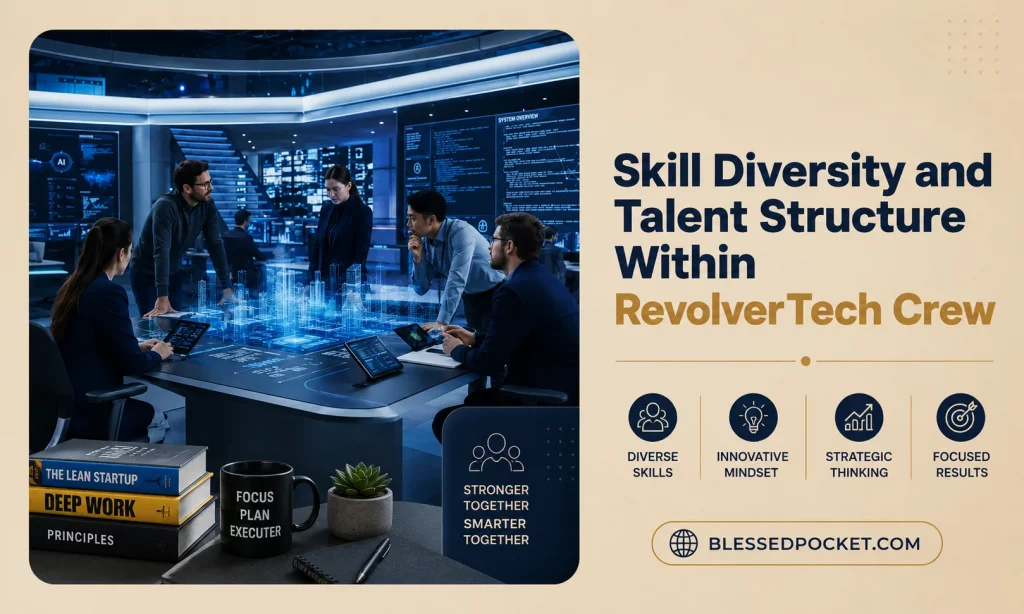
The crew is not a monoculture of developers. It brings together multiple disciplines that most organizations keep in separate departments.
| Skill Area | Role in the Crew |
|---|---|
| Software Development | Building products, writing clean code, full-stack capability |
| UX/UI Design | Ensuring products are intuitive, accessible, and human-centered |
| Product Strategy | Aligning technical work with market needs and user goals |
| Data Analysis | Informing decisions with evidence, not assumptions |
| Community Management | Building relationships, gathering feedback, growing trust |
| Content & Communication | Translating technical work into clear, compelling language |
How Cross-Functional Teams Work
In a traditional company, a developer codes, a designer designs, and a strategist writes documents — often in sequence, with handoffs that lose context at each stage.
RevolverTech Crew structures work differently. A project might include a developer, a designer, and a strategist working simultaneously, not sequentially. Decisions happen in real time. Feedback loops are immediate. The result is faster iteration and fewer misunderstandings.
This model demands more from each member — communication skills, adaptability, comfort with ambiguity — but it produces work that feels cohesive rather than assembled.
RevolverTech Crew’s Approach to Innovation and Problem-Solving
The Innovation Workflow
Innovation at RevolverTech Crew is not a brainstorming session with sticky notes. It is a structured process that moves from problem identification to shipped solution without losing momentum.
The workflow follows a consistent rhythm. First, identify the actual problem — not the assumed one. Second, assemble the smallest team that can solve it. Third, prototype rapidly. Fourth, test with real users. Fifth, iterate based on feedback. Sixth, scale what works and kill what doesn’t.
This approach borrows from agile and lean methodologies but strips away the bureaucracy that often accompanies them in larger organizations. The goal is not perfect process. The goal is working products.
Why User Feedback Matters
RevolverTech Crew treats user feedback as the most important input in the development cycle. Not stakeholder opinions. Not internal assumptions. Actual user behavior and response.
This commitment shows up practically. Products are released in small, testable increments. User responses are gathered immediately. Adjustments happen in days, not quarters. The crew operates on the belief that you cannot innovate in a vacuum — you need the people you’re building for in the room, even if the room is digital.
Digital Presence and Community Influence of RevolverTech Crew
Key Elements of Their Online Presence
| Element | Description |
|---|---|
| Social Media | Active engagement across tech-focused platforms |
| Content Sharing | Insights, process breakdowns, lessons learned |
| Community Interaction | Direct responses, Q&A, open dialogue |
| Portfolio Work | Public examples of completed projects |
| Educational Content | Tutorials, frameworks, methodology explanations |
The crew does not just showcase finished work. It shares process. That transparency builds trust and attracts talent — both clients and collaborators — who align with the philosophy.
Impact on the Tech Community
RevolverTech Crew’s influence extends beyond the projects they complete. They model an alternative to traditional tech employment and agency structures. Freelancers see a path to collaborative work without joining a corporation. Developers see that cross-functional teams can function without hierarchy. Startups see a model for building products without over-hiring.
Their impact is less about market share and more about mind share. They are proving that a different way of working is not just possible — it’s effective.
Challenges and Growth Opportunities for RevolverTech Crew
Key Challenges
| Challenge | Description |
|---|---|
| Scaling without losing culture | Growth often brings hierarchy; maintaining fluidity requires intention |
| Client education | Not every client understands or trusts non-traditional structures |
| Talent retention | Cross-functional talent is in high demand |
| Revenue predictability | Project-based work can be less stable than retainer models |
| Brand recognition | Competing with established agencies for visibility |
Opportunities for Growth
Every challenge maps to an opportunity. Scaling thoughtfully — growing slowly enough to preserve culture while expanding capacity. Building educational content that teaches potential clients how the model works and why it delivers. Creating internal development paths that make the crew a place talent stays rather than leaves. And diversifying revenue through product development, licensing tools, or training programs that package the crew’s methodology for others to use.
The Future Outlook of RevolverTech Crew in the Tech Space
Key Future Trends
| Trend | How RevolverTech Crew Is Positioned |
|---|---|
| Remote-first work | Already built for distributed collaboration |
| Cross-functional teams | Core operating model, not a trend to adopt |
| User-centered design | Central to philosophy, not an afterthought |
| Agile at scale | Doing it without the bureaucracy that slows larger orgs |
| AI integration | Poised to adopt AI tools without losing human-centered focus |
| Community-driven development | Existing strength; direct user relationships already in place |
The tech industry is moving toward the model RevolverTech Crew already operates. That positions them ahead of companies still trying to transition from siloed structures to collaborative ones.
Fun Facts About RevolverTech Crew
The name “RevolverTech” reflects a rotating, adaptive structure.
Like a revolver cycling chambers, the crew rotates leadership and adapts roles based on what the project needs.
They operate without traditional hierarchy.
No corner offices. No rigid reporting lines. Leadership shifts based on expertise and project requirements.
User feedback is integrated into every development cycle.
Not as a survey after launch. As a core input throughout the build process.
Cross-functional teams are the default, not the exception.
Developers, designers, and strategists work together from day one of a project — not in handoff sequences.
They share their process publicly.
Transparency is part of the brand. They don’t just deliver work — they explain how it was built.
The model is designed to scale without breaking.
Growth is intentional, not aggressive. Culture is preserved by design, not by accident.
Conclusion
RevolverTech Crew is not trying to be the biggest tech company. They are trying to be the most coherent one.
Their model — cross-functional teams, user-focused development, rotating leadership — is not new in theory, but it is rare in practice. Most organizations talk about collaboration and agility. RevolverTech Crew structures themselves around those principles rather than bolting them onto an existing hierarchy.
The challenges are real. Scaling without losing identity. Educating clients who expect traditional structures. Competing with brands that have bigger budgets. But the opportunities are larger. The tech industry is moving in their direction, and they are already there.
Whether you found this page researching their philosophy, their structure, or just trying to understand what makes them different, the answer is the same: RevolverTech Crew is building products the way products should be built — with the right people in the right room, focused on the right problems.
Frequently Asked Questions
What is the RevolverTech Crew?
A tech collective that operates on principles of skill diversity, cross-functional collaboration, and user-focused innovation — structured differently from traditional tech companies or agencies.
How does the RevolverTech Crew differ from a traditional tech company?
They operate without rigid hierarchy, use rotating leadership based on expertise, and integrate cross-functional teams from the start of every project rather than working in siloed departments.
What industries does the RevolverTech Crew serve?
Their model is adaptable across industries. They work with startups, established companies, and community-focused projects that align with their philosophy.
Does the RevolverTech Crew use agile methodology?
Yes, but without the bureaucracy that often accompanies agile in large organizations. Their workflow borrows from agile and lean principles while prioritizing speed and real user feedback.
Can startups work with the RevolverTech Crew?
Yes. Startups are a natural fit — the crew’s flexible, cross-functional model aligns well with early-stage companies that need to move fast without over-hiring.
What makes RevolverTech Crew trustworthy?
Transparency in process, a portfolio of completed work, direct community engagement, and a philosophy that prioritizes user outcomes over internal politics.
What is the future focus of the RevolverTech Crew?
Expanding their model thoughtfully, building educational resources, exploring product development, and positioning themselves as a standard-bearer for collaborative tech work.

Eden Pen is a storyteller passionate about spreading positivity. As a contributor to Blessed Pocket, she crafts heartfelt content designed to encourage, inspire, and brighten your day, one word at a time.
Eden Pen
<a href="https://blessedpocket.com">Eden Pen</a> is a storyteller passionate about spreading positivity. As a contributor to Blessed Pocket, she crafts heartfelt content designed to encourage, inspire, and brighten your day, one word at a time.