Quick Summary
Introduction My grandfather was named William. His father was named William. And his father before him. In our family, the name stretched…
Introduction
My grandfather was named William. His father was named William. And his father before him. In our family, the name stretched back generations like a thread connecting us to ancestors we’d never met. When I asked my grandfather what the name meant, he straightened his posture and said with quiet pride, “It means resolute protector. Strong-willed warrior. It means someone who stands between danger and the people they love.”
I never forgot that.
William name meaning carries over a thousand years of history. It has been borne by kings and conquerors, by poets and playwrights, by saints and soldiers. It has survived wars, migrations, and changing fashions to remain one of the most enduringly popular names in the Western world. From William the Conqueror who changed the course of English history to Prince William who will one day sit on the British throne, this name has been associated with leadership, strength, and unwavering resolve.
If you’re searching for the William name meaning, you’re exploring one of the most respected and enduring names in history. William has been cherished for centuries because of its powerful meaning, royal heritage, and timeless appeal. From kings and presidents to actors and athletes, the name William has been associated with leadership, courage, and success across generations.
Quick Reference: William Name Meaning at a Glance
| Category | Detail |
|---|---|
| Name | William |
| Origin | Germanic (Old High German) |
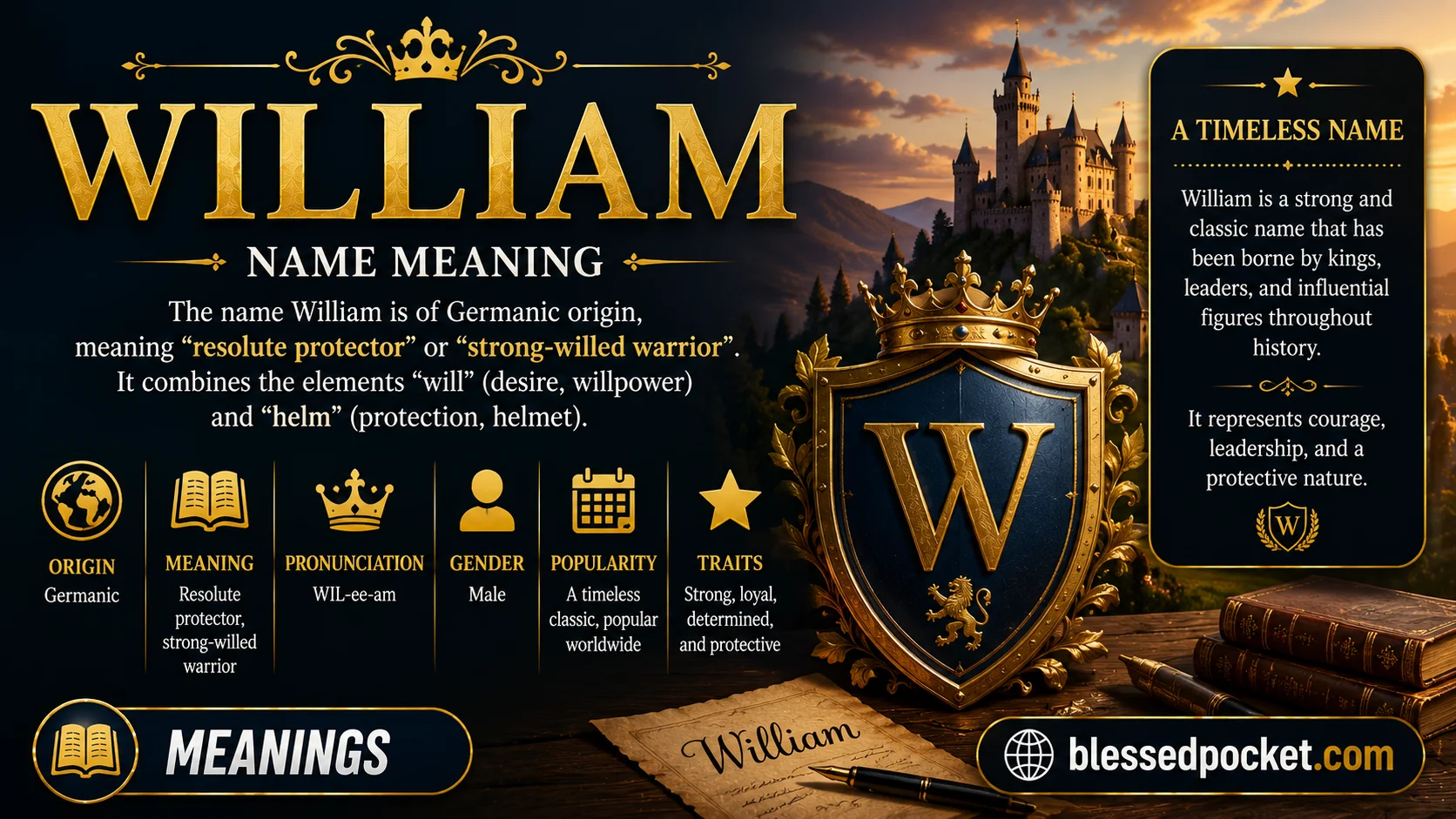
| Meaning | “Resolute protector,” “Strong-willed warrior” |
| Germanic Roots | “Wil” (will, desire, resolve) + “Helm” (helmet, protection) |
| Gender | Male |
| Pronunciation | WIL-yum / WIL-ee-um |
| Syllables | 2-3 |
| Popularity (2026) | Top 10 in USA, Top 20 in UK |
| Royal Connection | Four English kings named William; Prince William |
| Famous Namesakes | William Shakespeare, William the Conqueror, William Wallace |
| Spiritual Meaning | Strength, protection, determination, leadership |
| Numerology | Expression Number 7 (spiritual, analytical, wise) |
The Origin of William: From Germanic Warriors to English Kings
The Germanic Roots
The William name origin begins in the forests of ancient Germania. The name is derived from the Old High German Willahelm, composed of two elements:
| Element | Meaning | Significance |
|---|---|---|
| Wil | Will, desire, resolve, determination | Inner strength and purpose |
| Helm | Helmet, protection, guardian | Defender and protector |
Together, these elements form a name that means “resolute protector” or “strong-willed warrior.” It was a name given to boys with the hope that they would grow into men of courage—men who would stand firm in their convictions and protect those under their care.
The Norman Transformation
The name traveled from Germanic tribes to the Franks and eventually to the Normans—the Norse-descended people who settled in what is now northern France. In Norman French, Willahelm became Williame and later Guillaume. When William the Conqueror led the Norman invasion of England in 1066, he brought the name with him.
| Language/Culture | Form | Period |
|---|---|---|
| Old High German | Willahelm | 8th-11th centuries |
| Norman French | Williame / Guillaume | 10th-11th centuries |
| Old English | Willelm | Post-1066 |
| Middle English | William | 12th-15th centuries |
| Modern English | William | 16th century-present |
The Name That Conquered England
Before 1066, William was virtually unknown in England. After the Norman Conquest, it became one of the most popular names in the country—a dominance it has maintained, remarkably, for nearly a thousand years. Few names in history have shown such staying power.
The Meaning of William in Different Languages
| Language | Form | Meaning/Notes |
|---|---|---|
| English | William | Resolute protector |
| French | Guillaume | Same Germanic roots |
| German | Wilhelm | Same meaning |
| Dutch | Willem | Same meaning |
| Italian | Guglielmo | Same meaning |
| Spanish | Guillermo | Same meaning |
| Portuguese | Guilherme | Same meaning |
| Irish | Liam (diminutive) | Now a standalone name |
| Scottish | Uilleam | Gaelic form |
| Welsh | Gwilym | Celtic adaptation |
| Swedish | Vilhelm | Same meaning |
| Polish | Wilhelm | Same meaning |
| Czech | Vilém | Same meaning |
The name’s spread across Europe and the world is a testament to its enduring appeal. In every language, the meaning remains consistent: a person of strong will who protects others.
Is William a Biblical Name?
The Direct Answer
William does not appear directly in the Bible. The name emerged from Germanic culture centuries after the biblical canon was closed. You will not find a William in the Old or New Testament.
But Here’s the Deeper Truth
While the name William is not found in Scripture, the qualities it represents are deeply biblical. The Bible is filled with strong-willed protectors—men and women who stood firm in their convictions and defended the vulnerable.
| Biblical Figure | Connection to William’s Meaning |
|---|---|
| David | A shepherd who protected his flock and became a warrior king |
| Joshua | A strong-willed leader who brought God’s people into the Promised Land |
| Nehemiah | A resolute protector who rebuilt Jerusalem’s walls |
| Daniel | A man of unwavering resolve who refused to compromise his faith |
| Paul | A determined apostle who protected the early church |
| Michael (Archangel) | A warrior angel who protects God’s people in spiritual battle |
The Spiritual Meaning of William
| Spiritual Quality | Connection to the Name |
|---|---|
| Resolve | The “wil” element speaks to determination and steadfastness |
| Protection | The “helm” element speaks to guarding and defending others |
| Leadership | The name’s royal associations point to godly leadership |
| Courage | The warrior heritage points to bravery in the face of danger |
| Service | True protection requires self-sacrifice |
The William spiritual meaning is not about appearing in Scripture but about embodying biblical virtues. A William is called to be resolute in faith, protective of the vulnerable, and strong in the face of opposition—qualities that echo throughout the Bible.
Famous Williams Throughout History
Royal Williams
| Name | Title | Significance |
|---|---|---|
| William I (the Conqueror) | King of England (1066-1087) | Norman conqueror who transformed English history |
| William II (Rufus) | King of England (1087-1100) | Son of the Conqueror |
| William III | King of England, Scotland, Ireland (1689-1702) | Co-ruled with Mary II |
| William IV | King of the United Kingdom (1830-1837) | Preceded Queen Victoria |
| Prince William | Prince of Wales | Future King of the United Kingdom |
Cultural Williams
| Name | Known For |
|---|---|
| William Shakespeare | Greatest playwright in English history |
| William Wallace | Scottish freedom fighter |
| William Wordsworth | Romantic poet |
| William Blake | Poet and artist |
| William Wilberforce | Abolitionist who ended British slave trade |
| William Carey | Father of modern missions |
| William Booth | Founder of the Salvation Army |
| William Tyndale | First translator of the Bible into English |
William Name Personality: What the Name Says About Character
| Personality Trait | Association |
|---|---|
| Strong-willed | The name’s literal meaning—someone with determination |
| Protective | The “helm” element—a guardian and defender |
| Natural leader | Royal associations throughout history |
| Reliable | The name suggests steadfastness and dependability |
| Intelligent | Many famous Williams have been scholars and thinkers |
| Creative | From Shakespeare to Blake, artistic Williams abound |
| Principled | William Wilberforce, William Booth—men of conviction |
| Loyal | The protective nature extends to faithfulness in relationships |
Numerology of the Name William
| Numerology Aspect | Value | Meaning |
|---|---|---|
| Expression Number | 7 | Spiritual, analytical, wise, introspective |
| Soul Urge Number | 1 | Leadership, independence, ambition |
| Personality Number | 6 | Responsible, protective, nurturing |
The Expression Number 7 suggests someone drawn to deeper questions—spiritual, philosophical, analytical. The Soul Urge Number 1 indicates a natural leader. The Personality Number 6 reveals a protective, caring nature. Together, these numbers paint a picture of a person who is both thoughtful and strong—a leader who leads with wisdom rather than force.
William Name Popularity Over Time
| Year | USA Ranking | UK Ranking | Notes |
|---|---|---|---|
| 1800 | Top 5 | Top 5 | Extremely popular in English-speaking world |
| 1900 | Top 10 | Top 10 | Maintained strong position |
| 1950 | Top 20 | Top 15 | Slight decline but still very popular |
| 1980 | Top 30 | Top 30 | Competing with newer name trends |
| 2000 | Top 20 | Top 15 | Resurgence |
| 2010 | Top 10 | Top 10 | Strong comeback |
| 2020 | Top 5 | Top 10 | Near peak popularity |
| 2026 | Top 5 | Top 10 | Remains one of the most popular boys’ names |
Remarkably, William has never fallen out of the top 30 names in either the United States or the United Kingdom for over a century. It’s one of the few names that has been consistently popular across multiple eras.
Variations and Nicknames
| Variation | Language/Culture |
|---|---|
| Liam | Irish (now a standalone name) |
| Will | English (short form) |
| Bill | English (traditional nickname) |
| Billy | English (childhood/friendly) |
| Willie | English (traditional/vintage) |
| Wills | English (British royal family usage) |
| Guillaume | French |
| Guillermo | Spanish |
| Guglielmo | Italian |
| Wilhelm | German |
| Willem | Dutch |
| Guilherme | Portuguese |
The Liam Phenomenon
Liam began as an Irish short form of William but has become one of the most popular standalone names in the world. In the United States, Liam has been the #1 boys’ name for several years running. Many parents choose Liam for its simplicity while still connecting to the William tradition.
Sibling Names That Pair Well with William
| For Brothers | For Sisters |
|---|---|
| Henry | Elizabeth |
| Edward | Charlotte |
| James | Eleanor |
| Charles | Margaret |
| George | Catherine |
| Thomas | Victoria |
| Alexander | Isabella |
| Benjamin | Amelia |
| Oliver | Sophia |
| Samuel | Grace |
FAQ 🙋
Q: What does the name William mean?
The name William means “resolute protector” or “strong-willed warrior.” It comes from the Old High German elements “wil” (will, desire, resolve) and “helm” (helmet, protection). The name carries connotations of strength, leadership, and guardianship.
Q: Is William a biblical name?
William is not directly found in the Bible. It emerged from Germanic culture after the biblical canon was closed. However, the qualities the name represents—resolve, protection, leadership—are deeply biblical virtues embodied by figures like David, Joshua, and Nehemiah.
Q: What is the spiritual meaning of William?
The spiritual meaning of William encompasses determination, protective care, godly leadership, and steadfast faith. While not a biblical name, it has been borne by many significant Christian figures including William Tyndale (Bible translator), William Wilberforce (abolitionist), and William Booth (Salvation Army founder).
Q: Why is William such a popular name?
William has remained popular for nearly a thousand years due to its strong meaning, royal associations, timeless quality, and versatile nicknames (Will, Bill, Billy, Liam). It strikes a balance between traditional and fresh—familiar without feeling dated.
Q: How many kings have been named William?
Four English/British kings have been named William: William I (the Conqueror), William II (Rufus), William III (of Orange), and William IV. Prince William is expected to become William V when he ascends the throne.
Q: What are the best nicknames for William?
Popular nicknames include Will (classic and strong), Liam (modern and trendy), Bill/Billy (traditional and friendly), Wills (British royal style), and Wiley (unique and playful). The name offers nicknames for every personality and age.
Q: Is William a Catholic name?
William is used across all Christian denominations and by non-religious families. However, there are several saints named William, including Saint William of Gellone (8th century) and Saint William of York (12th century). The name has a rich Christian heritage.
Q: What are the best middle names for William?
William pairs well with shorter, stronger middle names: William James, William John, William Paul, William Cole, William Reid, William Scott. For a more formal pairing: William Alexander, William Nathaniel, William Theodore, William Edward.
Q: Why did Liam separate from William?
Liam began as the Irish Gaelic short form of William (Uilliam → Liam). Over time, it became so popular in its own right that it’s now treated as a completely independent name. Many parents choose Liam without any connection to William. It has been the #1 boys’ name in the United States for several years.
Conclusion 👑✨
William name meaning carries over a thousand years of weight. It began in the forests of ancient Germania as a name for warriors—men of resolve who protected their people. It crossed the English Channel with a conqueror and became the name of kings. It was carried by poets, reformers, and saints. And today, it rests on playgrounds and in boardrooms, on birth certificates and in family Bibles, a name that still whispers of strength and steadfastness.
If you’re considering this name for your child, you’re choosing more than a pleasant arrangement of syllables. You’re choosing a name that has been borne by some of the most significant figures in Western history. A name that means “resolute protector.” A name that has never gone out of style in nearly a thousand years. A name that will serve a boy well from childhood through manhood.
The name William says: You are strong. You are a protector. You come from a long line of those who stood for something greater than themselves.
If this blessed you, share it with someone considering baby names or curious about their own name. May every William know the strength and purpose his name contains. 👑🕊️✨

Eden Pen is a storyteller passionate about spreading positivity. As a contributor to Blessed Pocket, she crafts heartfelt content designed to encourage, inspire, and brighten your day, one word at a time.
Eden Pen
<a href="https://blessedpocket.com">Eden Pen</a> is a storyteller passionate about spreading positivity. As a contributor to Blessed Pocket, she crafts heartfelt content designed to encourage, inspire, and brighten your day, one word at a time.