
Quick Summary
Introduction The year was approximately 593 BC. A priest-turned-prophet sat by the Kebar River in Babylon, exiled from his homeland, surrounded by…
Introduction
The year was approximately 593 BC. A priest-turned-prophet sat by the Kebar River in Babylon, exiled from his homeland, surrounded by a defeated people who had lost everything. His name was Ezekiel. He was thirty years old. And on that ordinary day by an ordinary river in a foreign land, the heavens opened.
What Ezekiel saw would become the most detailed, mysterious, and breathtaking description of angels ever recorded in human history. Unlike the serene, winged humanoids of Renaissance paintings, Ezekiel biblical angels were terrifying whirlwinds of fire, lightning, eyes, wings, and faces. They moved with a sound like rushing waters. They were accompanied by wheels within wheels—structures so complex that scholars still debate their meaning 2,600 years later.
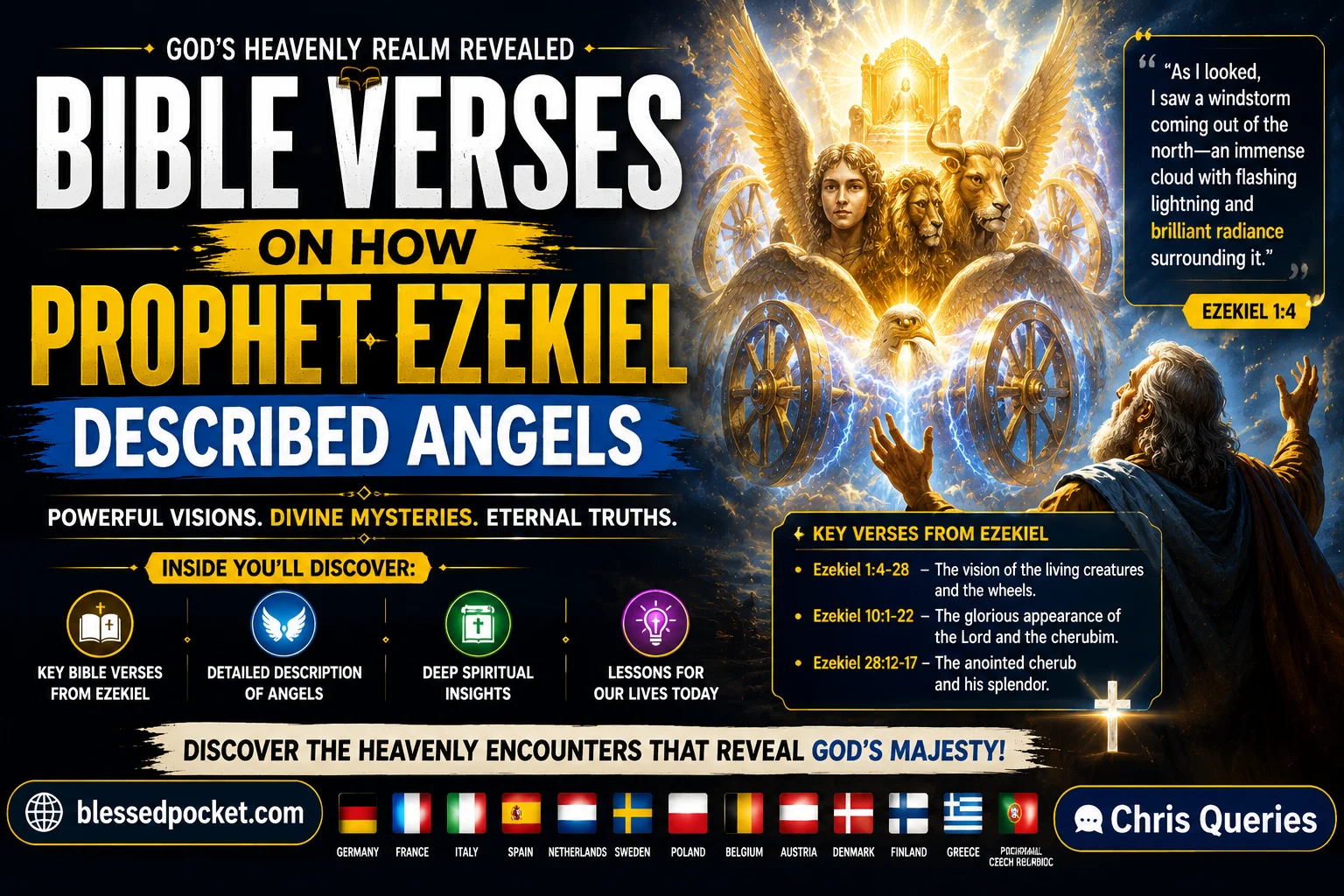
How does Ezekiel describe angels? Not as gentle guardians with feathered wings. Not as chubby cherubs floating on clouds. Ezekiel’s angels are overwhelming, multi-dimensional beings of fire and light whose very appearance caused him to fall on his face. His Ezekiel angel vision spans multiple chapters—primarily chapters 1 and 10—and provides the most detailed angelic description in all of Scripture.
This is the complete guide to Ezekiel description of angels. Every chapter. Every detail. Every verse. And the deep spiritual meaning behind the most extraordinary angelic descriptions in the Bible. 👁️✨
Quick Reference: Ezekiel Description of Angels at a Glance
| Chapter | Vision | Key Beings | Location |
|---|---|---|---|
| Ezekiel 1 | The Divine Chariot | Four Living Creatures, Wheels, Throne | Kebar River, Babylon |
| Ezekiel 3 | The Spirit’s Transport | The Spirit, Wings, Sound | The Plain |
| Ezekiel 8 | Temple Abominations | The Glory of God, Cherubim | Jerusalem (in vision) |
| Ezekiel 10 | The Glory Departs | Cherubim, Wheels, Fire | Jerusalem Temple |
| Ezekiel 11 | The Glory on the Mountain | Cherubim, Glory Cloud | East of Jerusalem |
| Ezekiel 43 | The Glory Returns | The Glory of God, Voice | New Temple Vision |
How Does Ezekiel Describe Angels? The Complete Breakdown
The Setting: By the Kebar River
Ezekiel 1:1-3 (NIV): “In my thirtieth year, in the fourth month on the fifth day, while I was among the exiles by the Kebar River, the heavens were opened and I saw visions of God. On the fifth of the month—it was the fifth year of the exile of King Jehoiachin—the word of the Lord came to Ezekiel the priest, the son of Buzi, by the Kebar River in the land of the Babylonians. There the hand of the Lord was on him.”
| Detail | Information |
|---|---|
| Prophet | Ezekiel, son of Buzi |
| Age at Time of Vision | 30 years old |
| Location | Kebar River, Babylon |
| Year | ~593 BC (5th year of Jehoiachin’s exile) |
| Circumstances | Among fellow exiles in Babylon |
| Trigger | “The heavens were opened” |
Ezekiel was not in the Temple. He was not in Jerusalem. He was a priest without a sanctuary, an exile in a pagan land. God chose this moment—this place of desolation and displacement—to reveal the most detailed Ezekiel angel vision in Scripture. The message was clear: God is not confined to the Temple. His throne is mobile. His glory can appear anywhere.
The Approach: A Storm From the North
Ezekiel 1:4 (NIV): “I looked, and I saw a windstorm coming out of the north—an immense cloud with flashing lightning and surrounded by brilliant light. The center of the fire looked like glowing metal.”
| Element | Description |
|---|---|
| Direction | From the north |
| First Appearance | A windstorm (whirlwind) |
| Cloud | Immense, massive |
| Lightning | Flashing continuously |
| Light | Brilliant, surrounding |
| Center | Fire that looked like glowing metal (amber/electrum) |
The vision begins not with serene beauty but with terrifying power. A storm. Lightning. Fire. The Hebrew word for “glowing metal” is chashmal—a rare word referring to polished bronze or electrum, an alloy of gold and silver that gleams with supernatural brilliance. This is not a gentle angelic visitation. This is an overwhelming display of divine power. How does Ezekiel describe angels? He begins with the atmosphere itself trembling at their approach.
Ezekiel Biblical Angels: The Four Living Creatures (Cherubim)
The Basic Description
Ezekiel 1:5-6 (NIV): “And in the fire was what looked like four living creatures. In appearance their form was human, but each of them had four faces and four wings.”
This is the core of the Ezekiel description of angels. These beings—later identified as cherubim in Ezekiel chapter 10—are unlike anything in popular culture. They have human-like form but are distinctly otherworldly. Their four faces and four wings set them apart from any earthly creature.
| Feature | Description | Scripture Reference |
|---|---|---|
| Number | Four living creatures | Ezekiel 1:5 |
| General Form | Human-like appearance | Ezekiel 1:5 |
| Faces | Four faces each | Ezekiel 1:6 |
| Wings | Four wings each | Ezekiel 1:6 |
| Legs | Straight, with feet like a calf’s hoof | Ezekiel 1:7 |
| Feet | Gleaming like burnished bronze | Ezekiel 1:7 |
| Hands | Human hands under their wings | Ezekiel 1:8 |
| Movement | Moved straight ahead without turning | Ezekiel 1:9, 12 |
| Speed | Like flashes of lightning | Ezekiel 1:14 |
These Ezekiel biblical angels are powerful, multi-faced, multi-winged creatures of fire and light. Their straight legs suggest stability. Their bronze feet suggest judgment. Their human hands suggest capability and service. They are servants of the divine throne, and they move with terrifying speed and precision.
The Four Faces: A Deeper Look
Ezekiel 1:10 (NIV): “Their faces looked like this: Each of the four had the face of a human being, and on the right side each had the face of a lion, and on the left the face of an ox; each also had the face of an eagle.”
| Face | Position | Traditional Symbolism | What It Represents |
|---|---|---|---|
| Human | Front | Intelligence, rationality | Humanity; the image of God |
| Lion | Right side | Strength, royalty, courage | King of wild beasts; majesty |
| Ox (Bull) | Left side | Service, sacrifice, endurance | Domesticated strength; servanthood |
| Eagle | Back (implied) | Vision, swiftness, transcendence | King of birds; heavenly perspective |
The four faces have been interpreted throughout church history as representing:
| Interpretation | Human | Lion | Ox | Eagle |
|---|---|---|---|---|
| Four Gospels | Matthew (Christ’s humanity) | Mark (Christ’s royalty) | Luke (Christ’s servanthood) | John (Christ’s divinity) |
| Four Aspects of Christ | Incarnation | Resurrection | Sacrificial death | Ascension |
| Creation Categories | Humanity | Wild animals | Domesticated animals | Birds |
This is a crucial part of how Ezekiel describes angels—not as simple beings with one face, but as complex creatures representing multiple aspects of creation and divine purpose.
The Wings and Movement
Ezekiel 1:11-12 (NIV): “Such were their faces. They each had two wings spreading out upward, each wing touching that of the creature on either side; and each had two other wings covering its body. Each one went straight ahead. Wherever the spirit would go, they would go, without turning as they went.”
| Wing Detail | Description |
|---|---|
| Total Wings | Four per creature |
| Two Wings | Spread upward, touching wings of adjacent creatures |
| Two Wings | Covering their bodies (reverence, humility) |
| Movement | Straight ahead; no turning |
| Guidance | Directed by the Spirit |
The wings touching each other suggest unity and coordination among Ezekiel biblical angels. They move in perfect harmony, not independently. The two wings covering their bodies indicate reverence—even these mighty beings cover themselves in the presence of God. Their movement is governed entirely by the Spirit; they have no independent will in their service.
The Sound: Voice Like the Almighty
Ezekiel 1:24 (NIV): “When the creatures moved, I heard the sound of their wings, like the roar of rushing waters, like the voice of the Almighty, like the tumult of an army.”
| Sound Comparison | What It Evokes |
|---|---|
| Rushing waters | Power, continuity, overwhelming presence |
| Voice of the Almighty | Divine authority, thunder, majesty |
| Tumult of an army | Discipline, order, overwhelming force |
The sound was not delicate or ethereal. It was overwhelming. This is essential to understanding how Ezekiel describes angels—their very movement shakes the atmosphere with divine power.
The Wheels Within Wheels: Ezekiel’s Most Mysterious Vision
The Description of the Wheels
Ezekiel 1:15-16 (NIV): “As I looked at the living creatures, I saw a wheel on the ground beside each creature with its four faces. This was the appearance and structure of the wheels: They sparkled like topaz, and all four looked alike. Each appeared to be made like a wheel intersecting a wheel.”
| Wheel Detail | Description |
|---|---|
| Number | One wheel beside each creature (four total) |
| Material | Sparkled like topaz (beryl or chrysolite) |
| Structure | A wheel intersecting a wheel (wheel within a wheel) |
| Movement | Could move in any direction without turning |
| Rims | High and awesome; full of eyes all around |
| Connection | The spirit of the creatures was in the wheels |
The Eyes in the Wheels
Ezekiel 1:18 (NIV): “Their rims were high and awesome, and all four rims were full of eyes all around.”
| Feature | Description | Significance |
|---|---|---|
| Height of Rims | High and awesome (fearsome) | Imposing, intimidating size |
| Eyes | Full of eyes all around | Omniscience; nothing hidden from God’s sight |
| Coverage | All four rims, all around | Complete, total awareness |
The eyes in the wheels represent God’s omniscience. The divine throne sees everything. Nothing escapes its notice. There are no blind spots. This is a vital element of the Ezekiel description of angels—they are accompanied by structures that see everything.
The Movement of the Wheels
Ezekiel 1:19-21 (NIV): “When the living creatures moved, the wheels beside them moved; and when the living creatures rose from the ground, the wheels also rose. Wherever the spirit would go, they would go, and the wheels would rise along with them, because the spirit of the living creatures was in the wheels.”
| Movement Characteristic | Description |
|---|---|
| Synchronization | Wheels moved with the creatures |
| Elevation | Wheels rose when creatures rose |
| Direction | Any direction without turning |
| Source | The spirit of the creatures controlled the wheels |
The unity between the creatures and the wheels is absolute. The same spirit animates both. There is no separation between the angelic beings and their means of transport. This suggests that God’s presence and God’s movement are one.
Ezekiel Chapter 10: The Cherubim Revealed
The Identity Confirmed
Ezekiel 10:20 (NIV): “These were the living creatures I had seen beneath the God of Israel by the Kebar River, and I realized that they were cherubim.”
| Detail | Chapter 1 | Chapter 10 |
|---|---|---|
| Name Used | “Living Creatures” (Heb: chayot) | “Cherubim” (Heb: keruvim) |
| Setting | Kebar River, Babylon | Jerusalem Temple (in vision) |
| Revelation | Ezekiel sees them for the first time | Ezekiel recognizes them as cherubim |
| Significance | Initial vision | Confirmation of identity |
This is the moment when Ezekiel biblical angels are definitively identified. The mysterious “living creatures” of chapter 1 are revealed to be cherubim—the same class of angelic being that guarded the entrance to Eden with a flaming sword (Genesis 3:24).
The Full Description of Cherubim in Chapter 10
Ezekiel 10:12 (NIV): “Their entire bodies, including their backs, their hands and their wings, were completely full of eyes, as were their four wheels.”
| Feature | Chapter 10 Detail | Scripture |
|---|---|---|
| Eyes | Entire bodies, backs, hands, wings, wheels full of eyes | Ezekiel 10:12 |
| Faces | Cherub, human, lion, eagle (ox replaced by “cherub” face) | Ezekiel 10:14 |
| Wings | Four each; sound heard as far as outer court | Ezekiel 10:5 |
| Hands | What looked like human hands under wings | Ezekiel 10:8 |
| Wheels | Four wheels beside them; sparkling like topaz | Ezekiel 10:9 |
| Movement | Wheels moved with them; spirit of creatures in wheels | Ezekiel 10:16-17 |
The Glory Departs from the Temple
Ezekiel 10:18-19 (NIV): “Then the glory of the Lord departed from over the threshold of the temple and stopped above the cherubim. While I watched, the cherubim spread their wings and rose from the ground, and as they went, the wheels went with them. They stopped at the entrance of the east gate of the Lord’s house, and the glory of the God of Israel was above them.”
| Event | Detail |
|---|---|
| Movement | Glory departs from Temple threshold |
| Location | Stops above the cherubim |
| Cherubim Action | Spread wings, rise from ground |
| Wheels | Rise with them |
| New Position | East gate of the Temple |
| Significance | God’s presence leaving the Temple due to Israel’s sin |
This is one of the most tragic moments in the Old Testament. The glory of God—the Shekinah that had dwelt in the Temple since Solomon’s dedication—departs. The cherubim, who guard and transport the divine throne, carry it away. God is not bound to a building. When His people persist in rebellion, His presence can leave.
The Expanse and the Throne: Above the Cherubim
The Expanse (Firmament)
Ezekiel 1:22 (NIV): “Spread out above the heads of the living creatures was what looked something like a vault, sparkling like crystal, and awesome.”
| Element | Description | Meaning |
|---|---|---|
| Position | Above the heads of the creatures | Elevated, transcendent |
| Appearance | Like a vault (expanse, firmament) | Solid platform |
| Material | Sparkling like crystal | Purity, clarity, brilliance |
| Effect | Awesome (fearsome) | Overwhelming majesty |
The Throne Above the Expanse
Ezekiel 1:26 (NIV): “Above the vault over their heads was what looked like a throne of lapis lazuli, and high above on the throne was a figure like that of a man.”
| Element | Description | Scripture |
|---|---|---|
| Position | Above the expanse | Ezekiel 1:26 |
| Throne Material | Lapis lazuli (sapphire) | Ezekiel 1:26 |
| Figure on Throne | “A figure like that of a man” | Ezekiel 1:26 |
| Upper Body | Like glowing metal, full of fire | Ezekiel 1:27 |
| Lower Body | Like fire, brilliant light surrounding | Ezekiel 1:27 |
| Radiance | Like a rainbow in the clouds | Ezekiel 1:28 |
The Appearance of the Lord
Ezekiel 1:27-28 (NIV): “I saw that from what appeared to be his waist up he looked like glowing metal, as if full of fire, and that from there down he looked like fire; and brilliant light surrounded him. Like the appearance of a rainbow in the clouds on a rainy day, so was the radiance around him. This was the appearance of the likeness of the glory of the Lord.”
| Element | Description |
|---|---|
| Upper Body | Glowing metal (chashmal/electrum), full of fire |
| Lower Body | Fire, brilliant light |
| Surrounding | Brilliant light, rainbow radiance |
| Identification | “The appearance of the likeness of the glory of the Lord” |
Ezekiel is careful with his language. He doesn’t say “I saw the Lord.” He says he saw “the appearance of the likeness of the glory of the Lord.” He’s describing the indescribable, using comparative language—”like,” “as if,” “appearance of”—to communicate something that transcends human language. This is the culmination of the Ezekiel description of angels: they exist to serve and transport the divine throne.
Comparison Table: Ezekiel Biblical Angels vs. Other Biblical Angelic Descriptions
| Feature | Ezekiel’s Cherubim | Isaiah’s Seraphim | John’s Living Creatures (Revelation 4) |
|---|---|---|---|
| Number | Four | Unspecified (multiple) | Four |
| Faces | Human, Lion, Ox, Eagle | Not described (faces covered?) | Lion, Ox, Man, Eagle |
| Wings | Four each | Six each | Six each |
| Position | Beneath God’s throne | Above God’s throne | Around God’s throne |
| Function | Transport divine throne | Worship, purification | Worship, lead worship |
| Eyes | All over bodies and wheels | Not described | All over, even under wings |
| Sound | Like rushing waters, army | Calling to each other | Never stop saying “Holy” |
| Scripture | Ezekiel 1, 10 | Isaiah 6:1-7 | Revelation 4:6-8 |
Complete List of Bible Verses: Ezekiel Description of Angels
Ezekiel Chapter 1: The Initial Vision
| Verse | Description |
|---|---|
| Ezekiel 1:1-3 | The heavens opened; Ezekiel saw visions of God by the Kebar River |
| Ezekiel 1:4 | A windstorm from the north—immense cloud, lightning, brilliant light, glowing metal |
| Ezekiel 1:5 | Four living creatures with human form |
| Ezekiel 1:6 | Each had four faces and four wings |
| Ezekiel 1:7 | Legs straight; feet like a calf’s hoof, gleaming like burnished bronze |
| Ezekiel 1:8 | Human hands under their wings on all four sides |
| Ezekiel 1:9 | Wings touched one another; moved straight ahead without turning |
| Ezekiel 1:10 | Four faces: human, lion, ox, eagle |
| Ezekiel 1:11 | Wings spread upward, two touching neighbor, two covering body |
| Ezekiel 1:12 | Each went straight ahead, wherever the spirit would go |
| Ezekiel 1:13 | Appearance like burning coals of fire, lightning among them |
| Ezekiel 1:14 | Creatures sped back and forth like flashes of lightning |
| Ezekiel 1:15-16 | A wheel on the ground beside each creature; wheel intersecting a wheel |
| Ezekiel 1:17 | Wheels moved in any direction without turning |
| Ezekiel 1:18 | Rims high and awesome, full of eyes all around |
| Ezekiel 1:19-21 | Wheels moved with creatures; spirit of creatures was in the wheels |
| Ezekiel 1:22 | Expanse above their heads, sparkling like crystal |
| Ezekiel 1:23 | Wings straight under the expanse, touching each other |
| Ezekiel 1:24 | Sound of wings like rushing waters, voice of the Almighty, tumult of army |
| Ezekiel 1:25 | Voice from above the expanse; creatures stopped and lowered wings |
| Ezekiel 1:26 | Throne of lapis lazuli above expanse; figure like a man on the throne |
| Ezekiel 1:27 | Figure like glowing metal full of fire; brilliant light surrounding |
| Ezekiel 1:28 | Rainbow radiance around him; this was the appearance of the glory of the Lord |
Ezekiel Chapter 3: The Spirit’s Transport
| Verse | Description |
|---|---|
| Ezekiel 3:12 | The Spirit lifted Ezekiel; heard the sound of the creatures’ wings |
| Ezekiel 3:13 | Sound of wings touching each other, wheels beside them—a great rumbling sound |
| Ezekiel 3:14 | The Spirit lifted Ezekiel and took him away |
| Ezekiel 3:15 | Came to exiles at Tel Aviv by the Kebar River; sat overwhelmed for seven days |
Ezekiel Chapter 10: The Cherubim and Departing Glory
| Verse | Description |
|---|---|
| Ezekiel 10:1 | Saw throne of lapis lazuli above the expanse over the cherubim |
| Ezekiel 10:2 | Lord tells man in linen to take fire from among the cherubim |
| Ezekiel 10:3 | Cherubim standing on south side of Temple; cloud filled inner court |
| Ezekiel 10:4 | Glory of the Lord rose from above cherubim to Temple threshold |
| Ezekiel 10:5 | Sound of cherubim wings heard as far as outer court—like voice of God Almighty |
| Ezekiel 10:6-7 | Man in linen takes fire from among cherubim |
| Ezekiel 10:8 | Under wings of cherubim was what looked like human hands |
| Ezekiel 10:9 | Four wheels beside cherubim—sparkling like topaz |
| Ezekiel 10:10 | All four wheels looked alike—wheel intersecting a wheel |
| Ezekiel 10:11 | Wheels could move in any direction without turning |
| Ezekiel 10:12 | Entire bodies, backs, hands, wings—including wheels—full of eyes |
| Ezekiel 10:13 | Heard wheels called “the whirling wheels” |
| Ezekiel 10:14 | Each cherub had four faces: cherub, human, lion, eagle |
| Ezekiel 10:15 | Cherubim rose—same creatures Ezekiel had seen by Kebar River |
| Ezekiel 10:16-17 | Wheels moved with cherubim; spirit of creatures was in the wheels |
| Ezekiel 10:18 | Glory of the Lord departed from Temple threshold; stopped above cherubim |
| Ezekiel 10:19 | Cherubim spread wings, rose; wheels with them; stopped at east gate |
| Ezekiel 10:20 | Ezekiel realized these were cherubim—same as vision at Kebar River |
| Ezekiel 10:21 | Each had four faces, four wings; under wings what looked like human hands |
| Ezekiel 10:22 | Faces same as those seen by Kebar River; each went straight ahead |
Ezekiel Chapter 11: Glory on the Mountain
| Verse | Description |
|---|---|
| Ezekiel 11:22 | Cherubim spread wings; wheels beside them; glory of God above them |
| Ezekiel 11:23 | Glory of the Lord went up from city; stopped above mountain east of Jerusalem |
| Ezekiel 11:24 | Spirit lifted Ezekiel; brought him back to exiles in Babylon; vision ended |
Ezekiel Chapter 43: The Glory Returns
| Verse | Description |
|---|---|
| Ezekiel 43:2 | Glory of God coming from east; voice like rushing waters; earth radiant |
| Ezekiel 43:3 | Vision like the one by Kebar River; Ezekiel fell facedown |
| Ezekiel 43:4 | Glory of the Lord entered Temple through east gate |
| Ezekiel 43:5 | Spirit lifted Ezekiel; brought him into inner court; glory filled Temple |
The Significance of How Ezekiel Describes Angels
1. God Is Not Confined to a Location
Ezekiel saw the divine throne—carried by cherubim, mounted on wheels—appearing in Babylon, departing from the Jerusalem Temple, and returning in a future vision. The message was radical for exiles who thought God lived exclusively in the Temple: God’s presence is mobile. He is with His people wherever they are.
2. Angels Are Not What Popular Culture Imagines
How does Ezekiel describe angels? In a way that shatters every sentimental notion of angels as gentle, winged humans. They are fearsome, multi-faced, multi-winged creatures of fire and lightning. Their appearance is overwhelming. Their sound is deafening. They inspire terror, not comfort—which is why angels in Scripture almost always begin with “Do not be afraid.”
3. God’s Glory Transcends Description
Ezekiel’s repeated use of comparative language—”like,” “as if,” “appearance of,” “what looked like”—reveals a prophet struggling to describe the indescribable. He doesn’t claim to have seen God directly. He saw “the appearance of the likeness of the glory of the Lord.” Even that was enough to make him fall facedown.
4. The Eyes Represent Omniscience
The eyes covering the cherubim and the wheels represent God’s complete knowledge. Nothing escapes His sight. There are no blind spots in the divine vision. For the exiles who wondered if God had forgotten them, this was reassurance: He sees everything.
5. The Mobility Represents God’s Sovereignty
The wheels within wheels, moving in any direction without turning, represent God’s ability to act anywhere, anytime, without limitation. He is not constrained by physics, geography, or human expectation.
FAQ 🙋
Q: How does Ezekiel describe angels in the Bible?
Ezekiel describes angels as four living creatures (cherubim) with human-like form, four faces (human, lion, ox, eagle), four wings, straight legs with bronze feet, and human hands under their wings. They are accompanied by wheels within wheels full of eyes. They move with the sound of rushing waters and the voice of the Almighty. Their appearance is like burning coals of fire with lightning flashing among them.
Q: What are Ezekiel biblical angels called?
Ezekiel initially calls them “living creatures” (Hebrew: chayot) in chapter 1. In chapter 10, he identifies them as “cherubim” (Hebrew: keruvim). This is the same class of angelic being that guarded the Garden of Eden with a flaming sword after Adam and Eve were expelled (Genesis 3:24).
Q: How many angels did Ezekiel see?
Ezekiel saw four living creatures (cherubim) in his primary vision. They appear together as a group, working in perfect coordination. He also describes four wheels associated with each creature and the divine throne above them all.
Q: What do the four faces of Ezekiel’s angels represent?
The four faces represent different aspects of creation and divine purpose. The human face represents intelligence and the image of God. The lion face represents strength, royalty, and courage. The ox face represents service, sacrifice, and endurance. The eagle face represents vision, swiftness, and transcendence. Church tradition also associates them with the four Gospels.
Q: What are the wheels within wheels in Ezekiel’s vision?
The wheels within wheels represent God’s mobility, omnipresence, and sovereignty. They sparkle like topaz, are full of eyes (representing omniscience), and can move in any direction without turning. They carry the divine throne, demonstrating that God’s presence is not confined to any location.
Q: How does Ezekiel’s description differ from other biblical angel descriptions?
Ezekiel’s description is the most detailed and sustained angelic description in Scripture. Isaiah’s seraphim (Isaiah 6) have six wings and focus on worship. John’s living creatures (Revelation 4) combine elements of both Ezekiel and Isaiah. Ezekiel provides the most architectural, almost engineering-like description of angelic beings and their associated structures.
Q: Why did the glory of God depart from the Temple in Ezekiel 10?
The glory departed because of Israel’s persistent idolatry and rebellion. Ezekiel chapters 8-11 describe the abominations being practiced in the Temple itself. God’s presence is holy and will not dwell where He is consistently rejected. The departure was an act of judgment, though the glory later returns in Ezekiel 43.
Conclusion 👁️✨
Ezekiel description of angels stands alone in Scripture for its detail, its mystery, and its overwhelming power. No other biblical writer gives us such a sustained, carefully observed account of angelic beings. From the four faces to the wheels within wheels, from the sound like rushing waters to the eyes covering every surface, Ezekiel’s vision has captivated readers for 2,600 years.
How does Ezekiel describe angels? Not as gentle guardians. Not as chubby cherubs. But as fearsome agents of the divine throne—brilliant, multi-dimensional, and absolutely submitted to the Spirit that directs them. They carried the glory of God away from a Temple defiled by idolatry. They would carry it back in a future vision of hope.
The Ezekiel biblical angels remind us that the spiritual realm is more vast, more mysterious, and more powerful than our imaginations can grasp. The cherubim Ezekiel saw were not comforting. They were terrifying. And yet they served a God who chose to reveal Himself to a priest in exile by a river in Babylon.
When you read how Ezekiel describes angels, you’re not just reading ancient prophecy. You’re glimpsing a reality that transcends our physical world—a reality where beings of fire and light serve the throne of the Almighty, where wheels covered with eyes move at the direction of the Spirit, and where even the most powerful creatures cover themselves in the presence of the One who sits above the expanse.
The heavens opened for Ezekiel by a river in Babylon. They open still for those who seek to understand the glory of the Lord. 👁️✨🙏

Eden Pen is a storyteller passionate about spreading positivity. As a contributor to Blessed Pocket, she crafts heartfelt content designed to encourage, inspire, and brighten your day, one word at a time.
Eden Pen
<a href="https://blessedpocket.com">Eden Pen</a> is a storyteller passionate about spreading positivity. As a contributor to Blessed Pocket, she crafts heartfelt content designed to encourage, inspire, and brighten your day, one word at a time.